TP-LINK TL-7DR7299 Teardown: BE7200 Wi-Fi 7, Dual 10G Ports, Quad 2.5G Ports
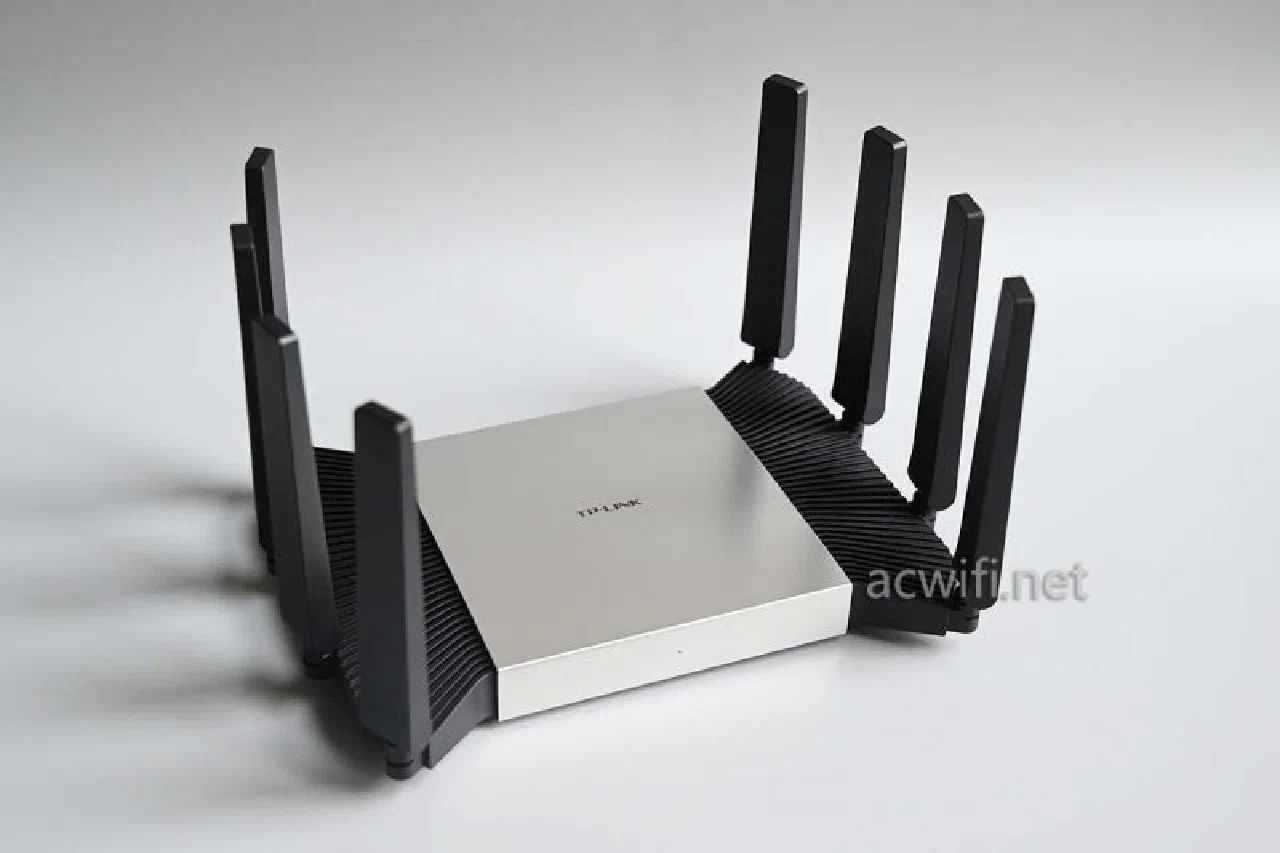
TABLE OF CONTENTS (Nhấn để xem)
The TP-Link TL-7DR7299 might easily be the coolest-running wireless router to date housed in the iconic “Feiliu” dual-band chassis (the classic mold shared with the XDR5480, XDR6080, and 7DR7290).
In the dual-band BE7200 Wi-Fi 7 space, the 7DR7299 makes a bold statement by packing dual 10-Gigabit ports (one 10G SFP+ optical cage and one 10G RJ45 copper port), accompanied by four 2.5GbE ports, two Gigabit ports, and a USB 3.0 Type-C interface—all under a price tag of roughly 999 RMB (around $140 USD).
Below is the complete board disassembly, semiconductor component breakdown, and bench performance validation originally conducted by ACWiFi.
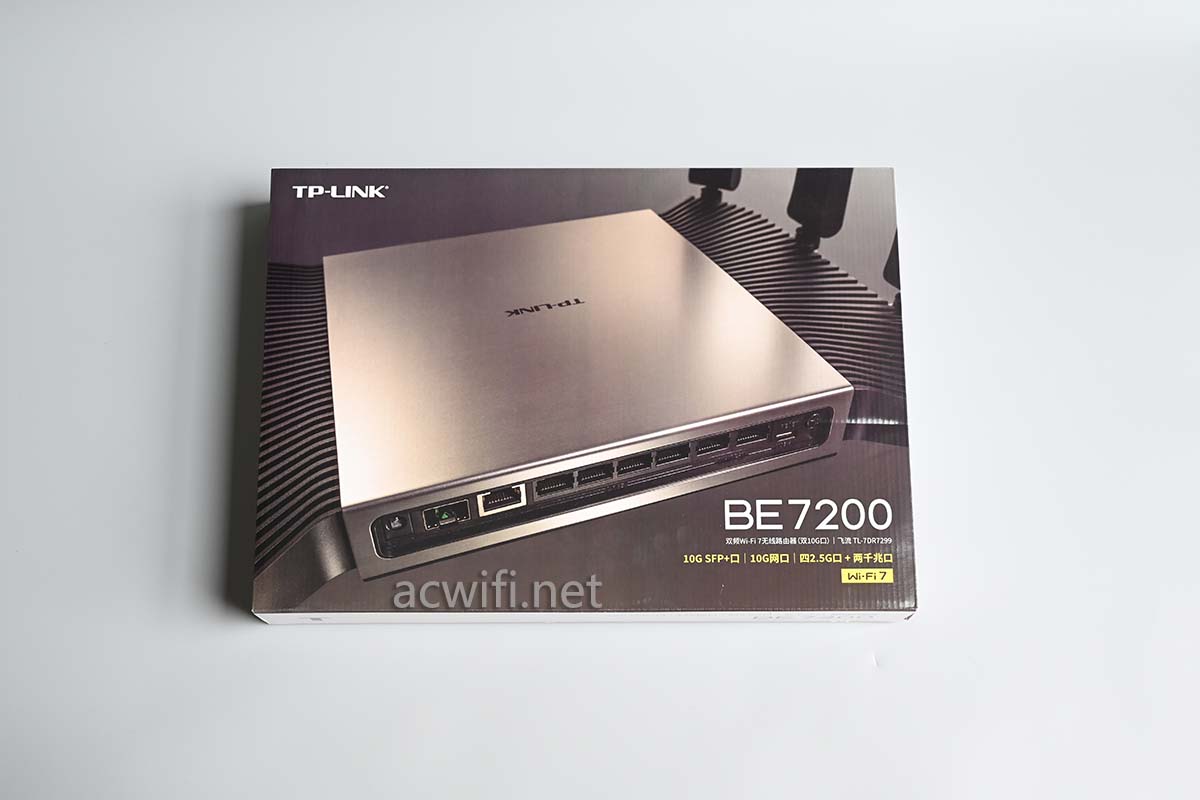
I. Unboxing, Accessories & Power Consumption
Inside the retail box, you’ll find the main TL-7DR7299 unit, a heavy-duty DC power adapter, and a molded patch cable:
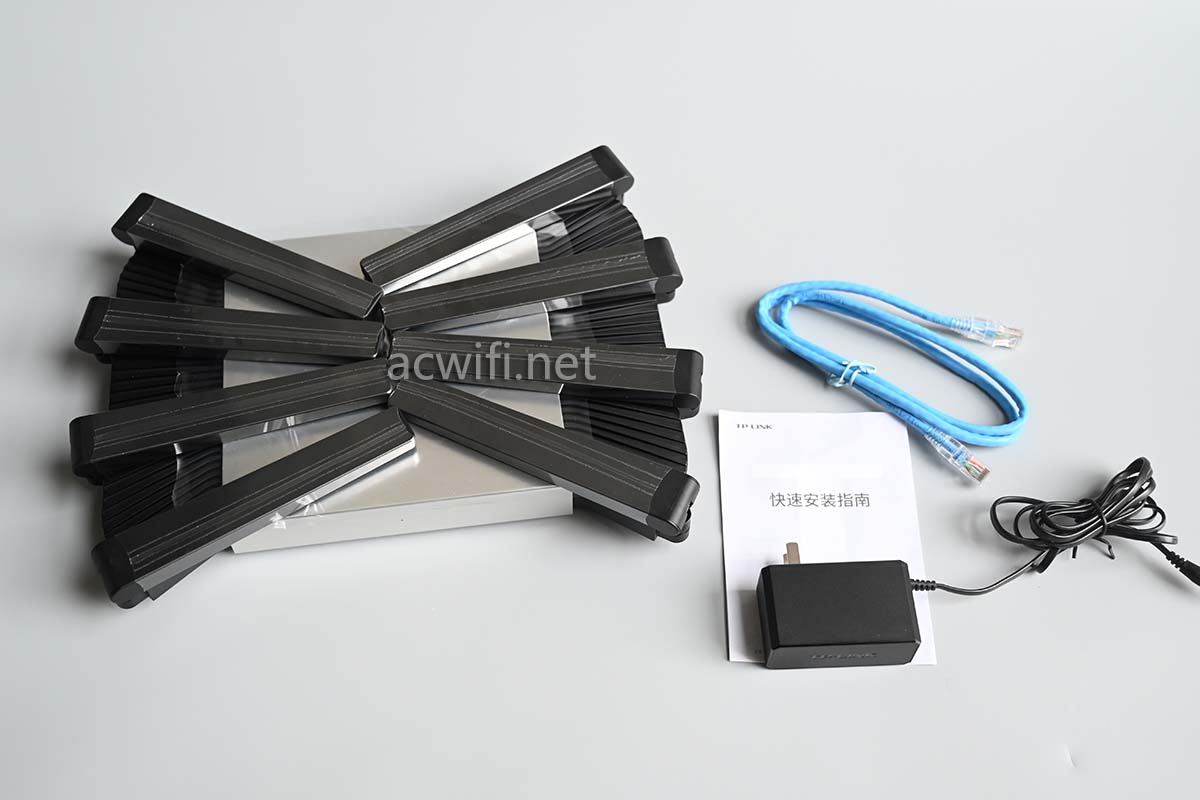
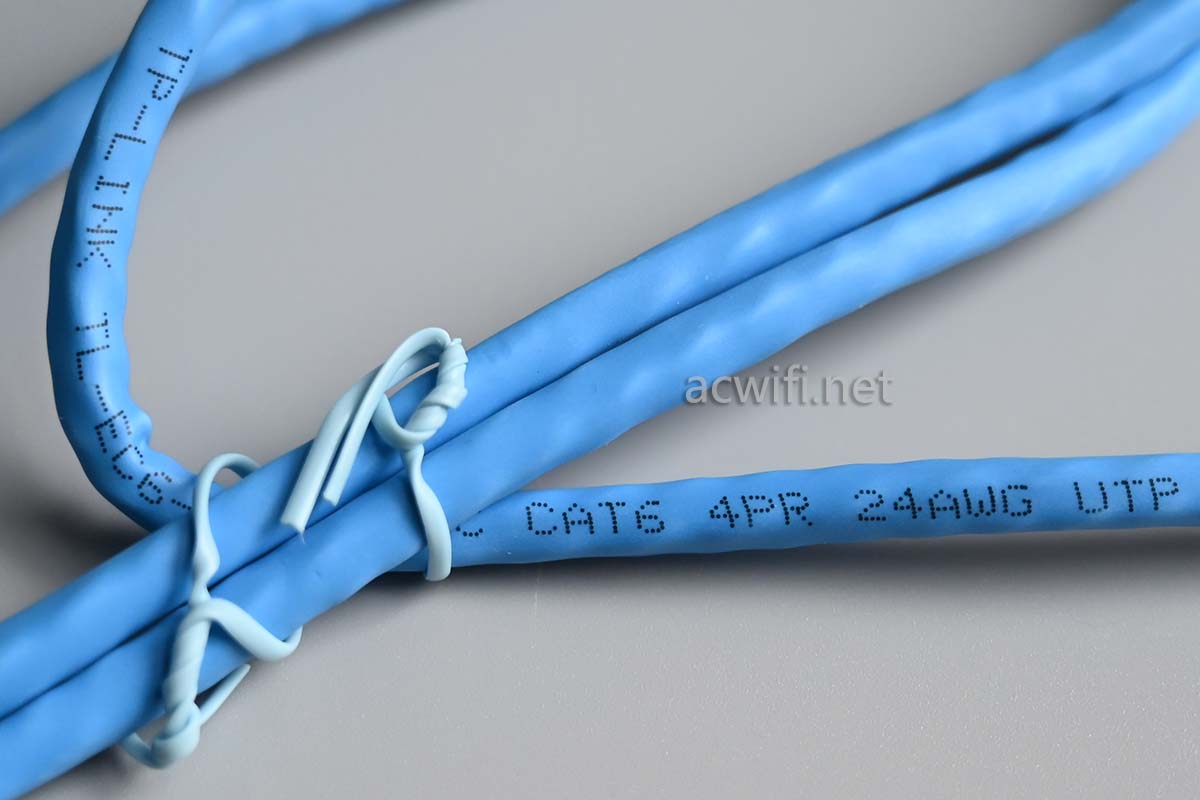
The bundled network cable is a Cat6 24AWG patch cord, manufactured directly in-house by TP-Link:
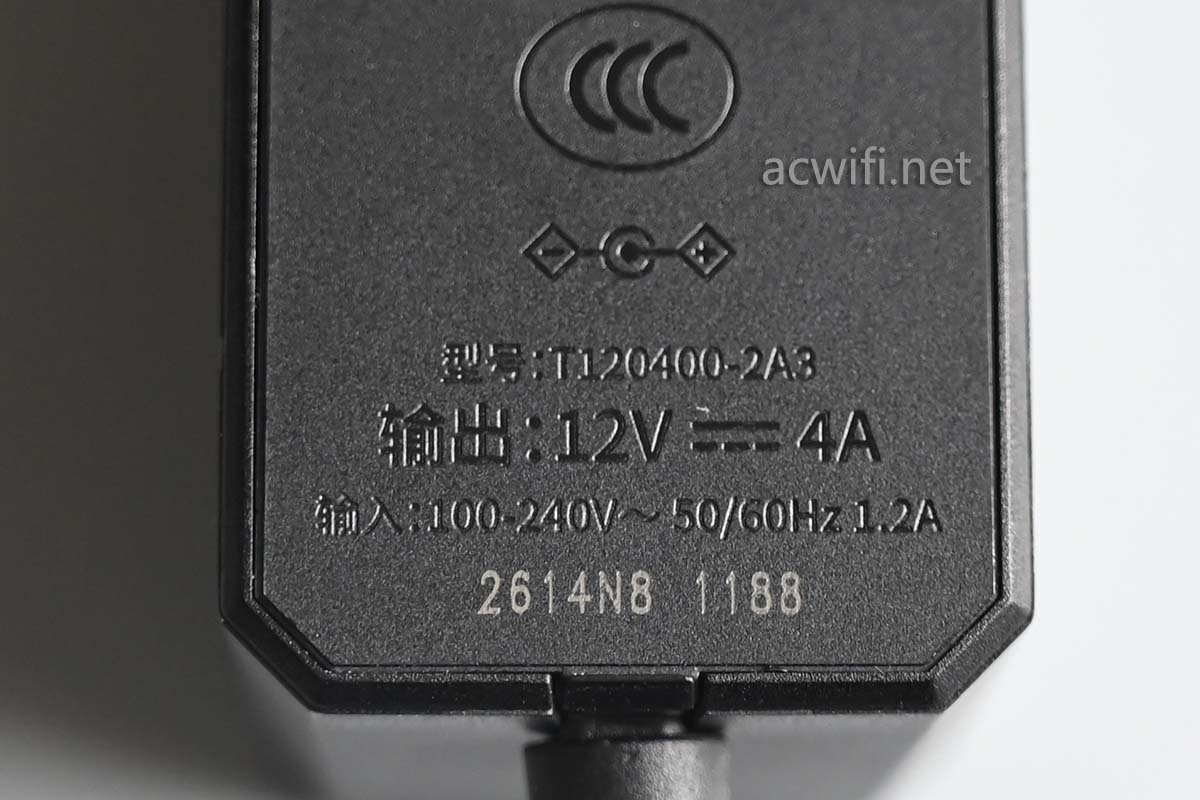
The power brick is rated at 12V / 4A (48W nominal output), providing plenty of headroom for active optical modules and USB storage:
Real-world power consumption measured at the wall:
- Standby idle (Wi-Fi active, no Ethernet cables plugged): 8.2W.
- With all four 2.5GbE ports linked: 10.8W.
- Adding one 10G multimode SFP+ optical transceiver and one 10G RJ45 link: 13.3W.
- Fully populated port configuration (all ports linked): 13.8W.
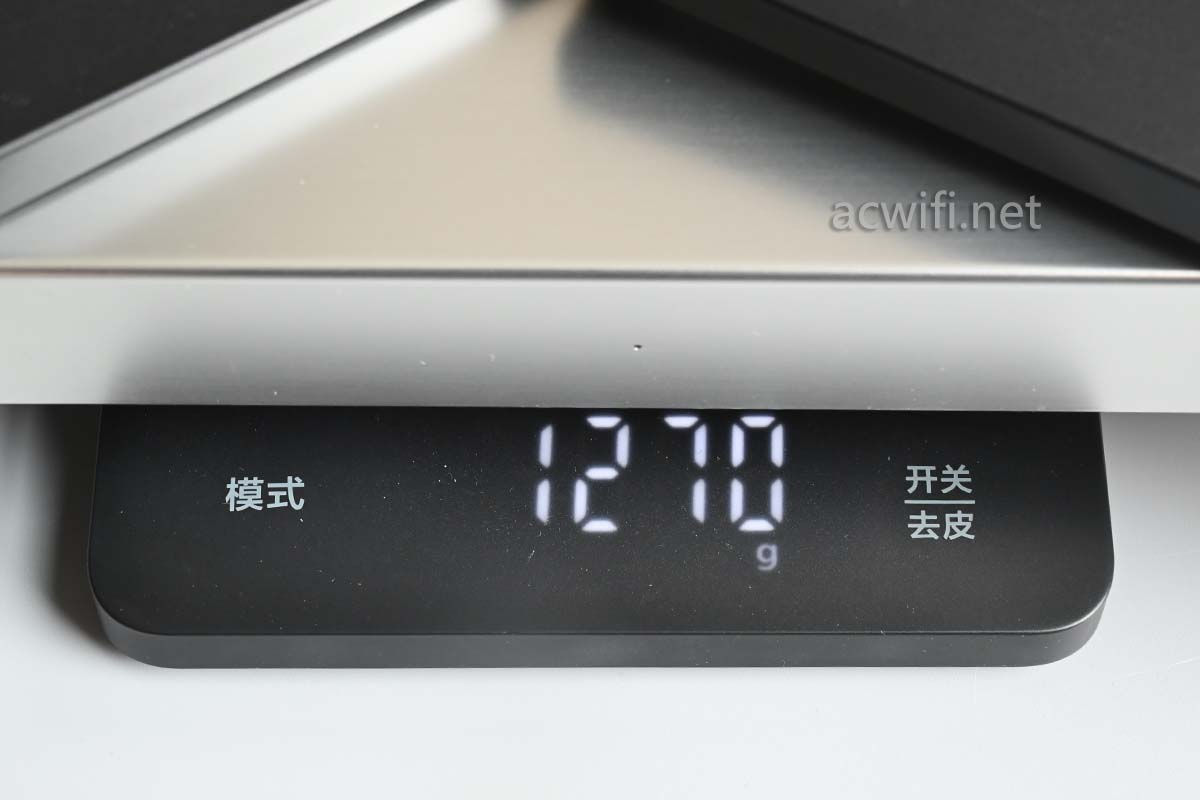
With protective films removed from the chassis and antennas, the bare unit weighs in at 1270 grams (retail packaged weight is 1994g):
II. Industrial Design, Antenna Array & Port Layout
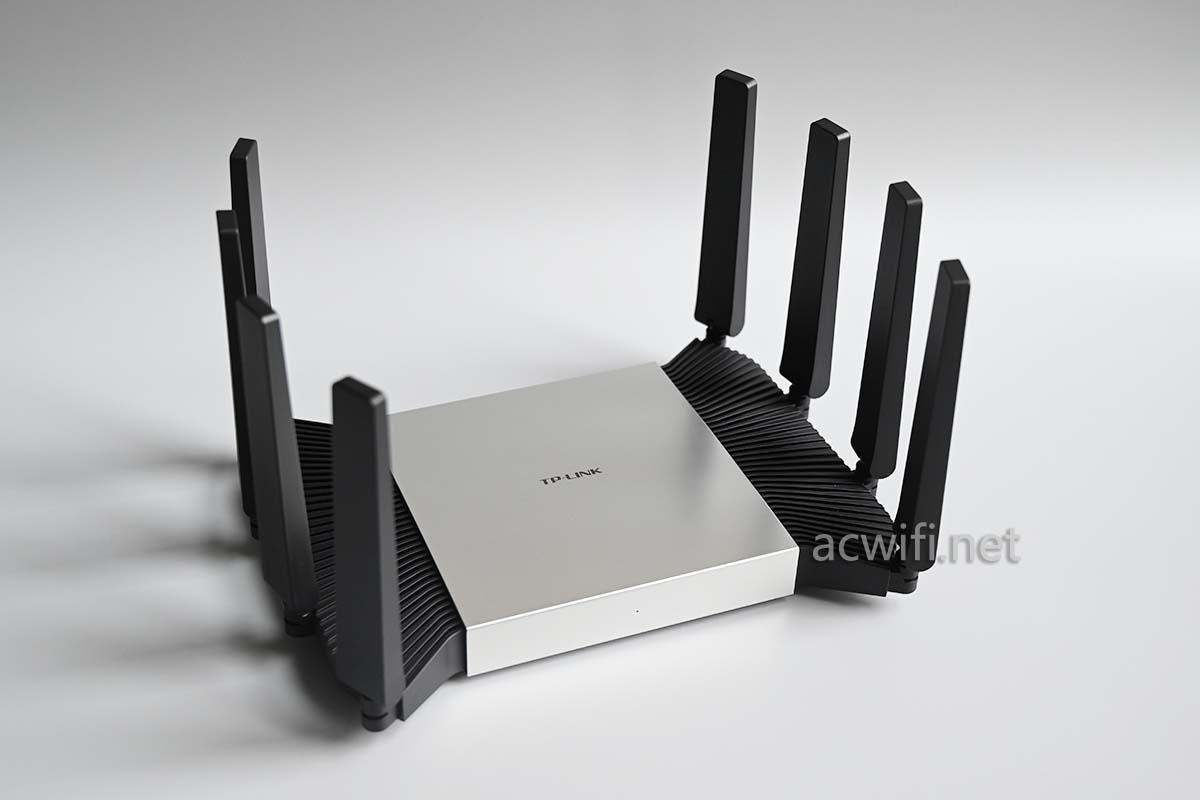
The TL-7DR7299 retains the aggressive, aerodynamic aesthetic of TP-Link’s Feiliu series. Router enthusiasts frequently note that any model sharing this chassis chassis provides consistently reliable RF coverage and strong convection cooling:
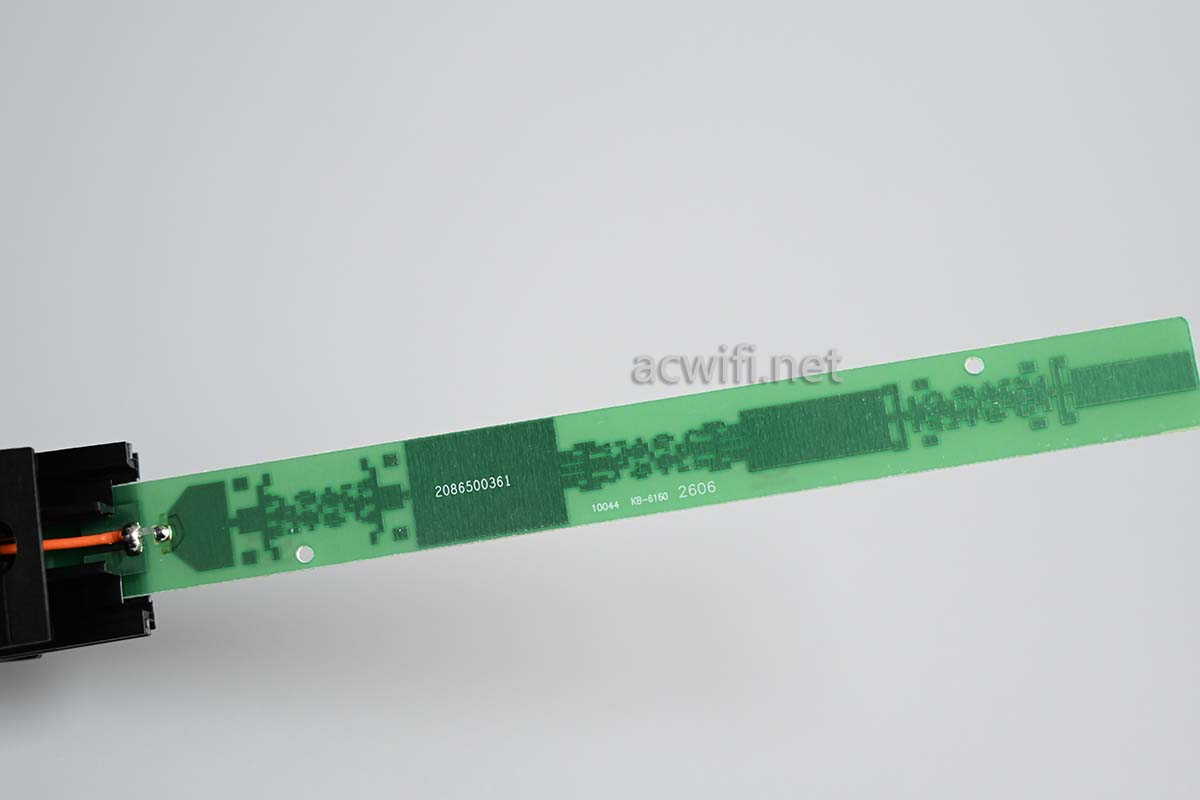
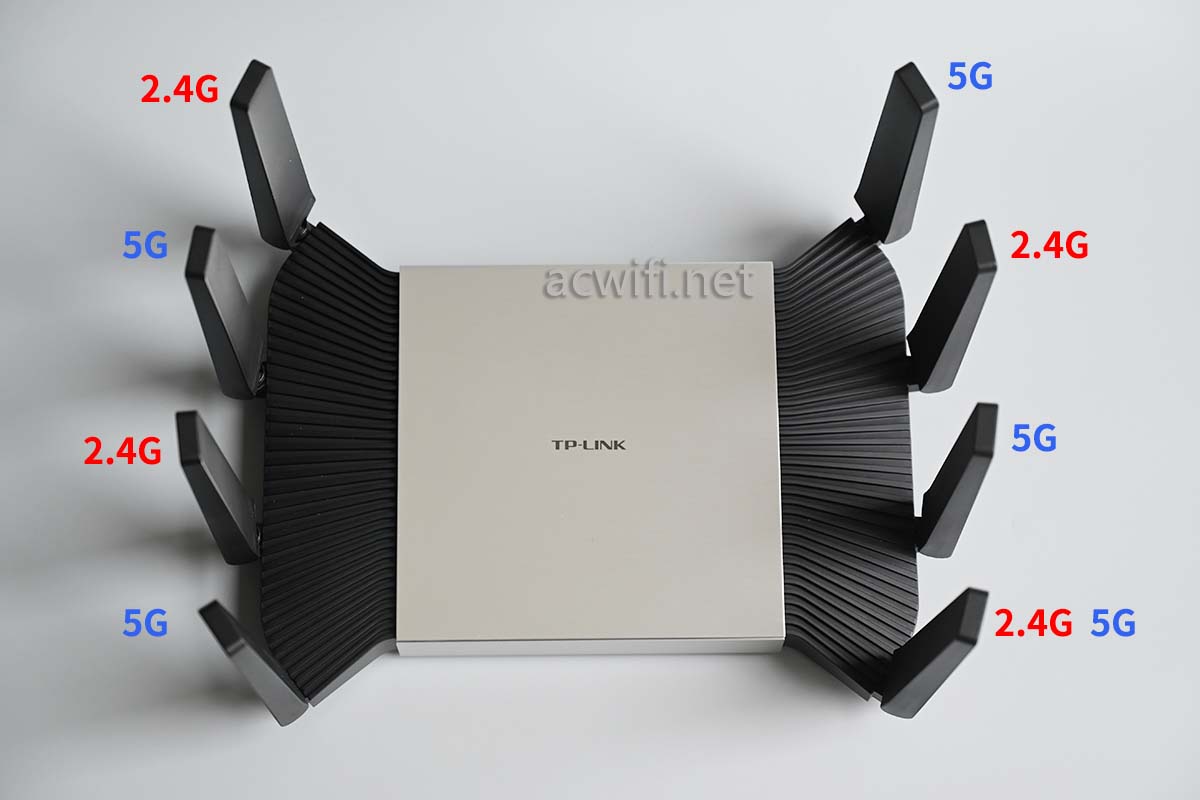
The external antennas feature a “Pixel Antenna” geometric layout, designed to enhance directional gain and signal propagation:
Antenna distribution across the 2.4GHz and 5GHz bands:
- 2.4GHz utilizes a 4T4R configuration (4 transmit, 4 receive streams).
- 5GHz utilizes a 4T5R configuration (4 transmit, 5 receive streams) to boost client uplink reception.
- Because the 5GHz radio connects five distinct antenna paths, one of the six external antennas is a dual-band element (serving both 2.4G and 5G), while the remaining five are single-band dedicated antennas:
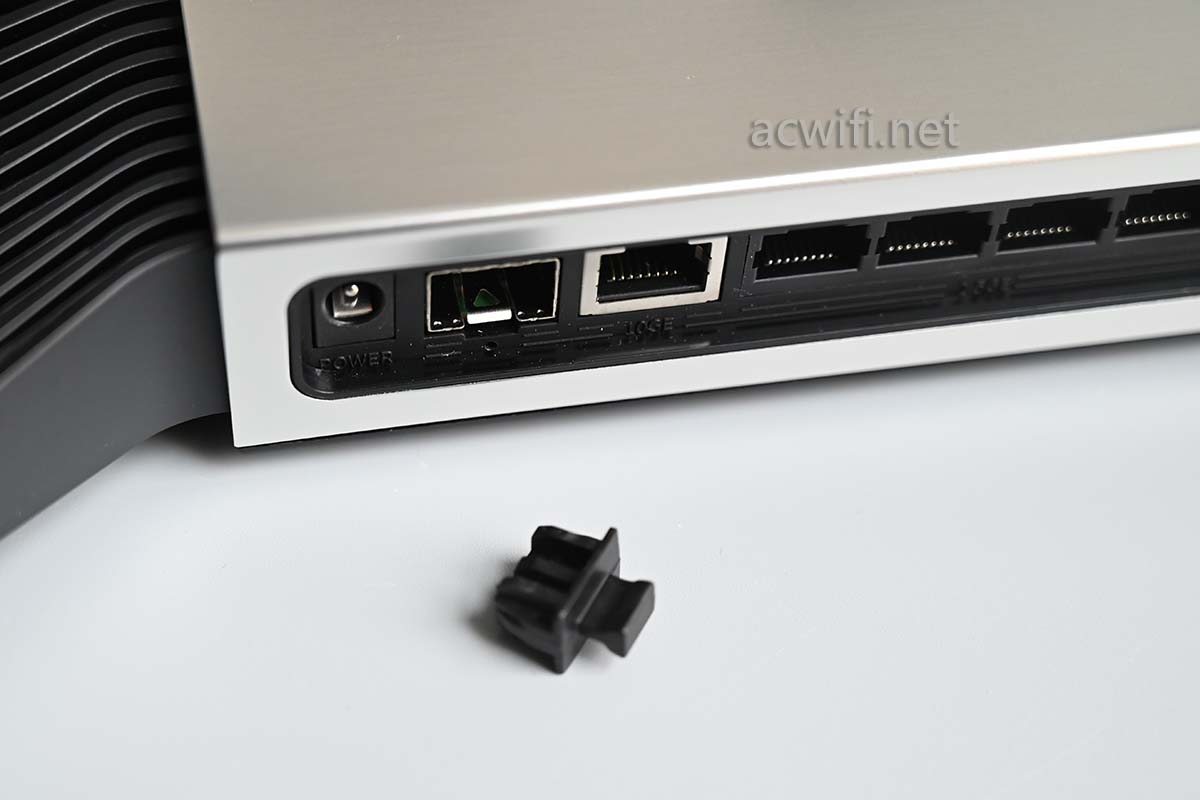
The rear I/O layout is the centerpiece of the device: Dual 10G interfaces, featuring one 10G SFP+ cage alongside a 10G multi-gigabit copper RJ45 port:
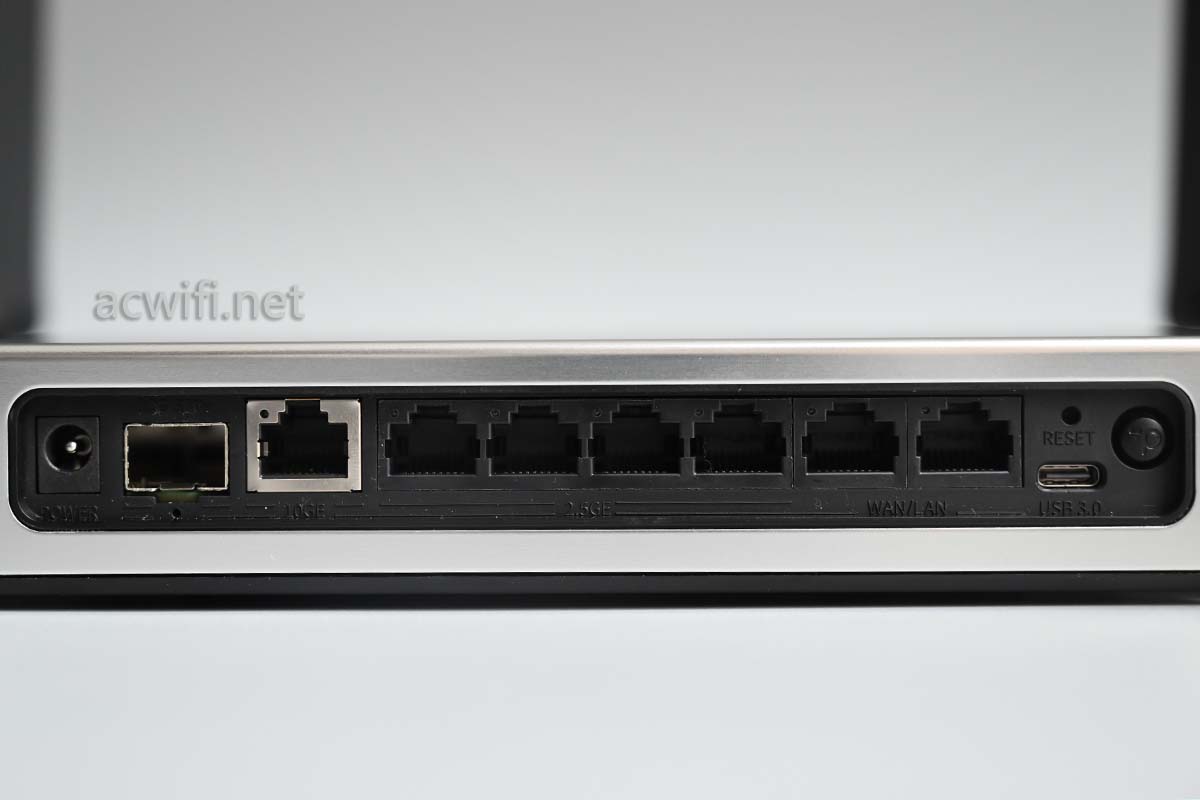
Rounding out the connectivity array are four 2.5GbE ports, two 1GbE ports, and a USB 3.0 Type-C port:
The bottom panel features an extensive honeycomb mesh pattern for passive convective intake:
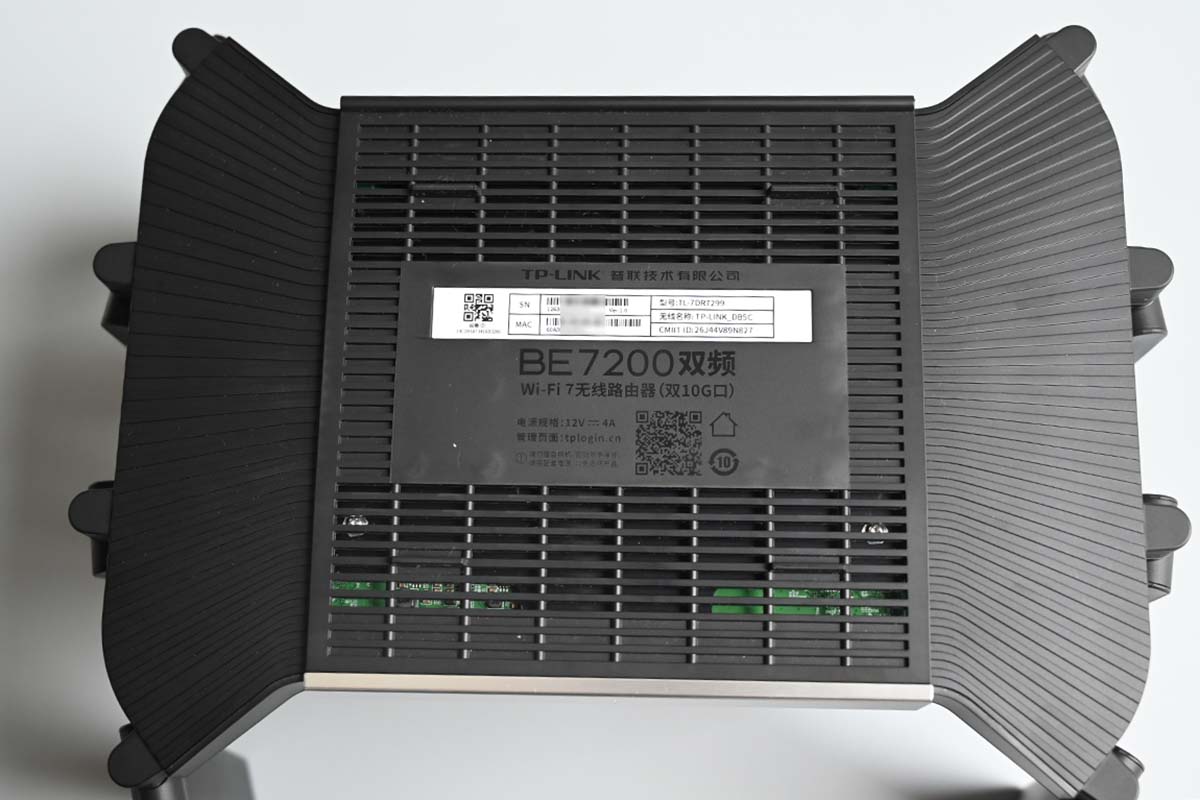
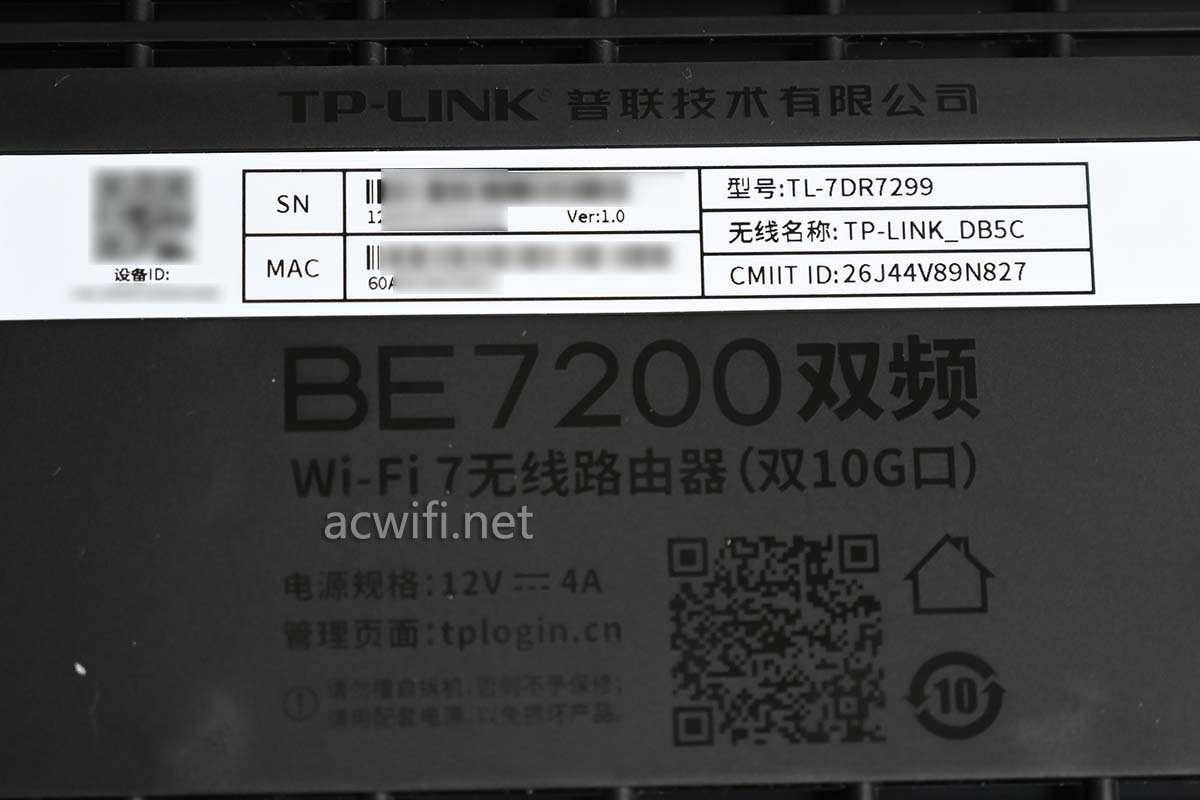
The regulatory label confirms the model identifier as TL-7DR7299, hardware version v1.0:
III. PCB Teardown & Thermal Management
Removing two screws concealed beneath the bottom label allows prying open the snap-fit perimeter clips:
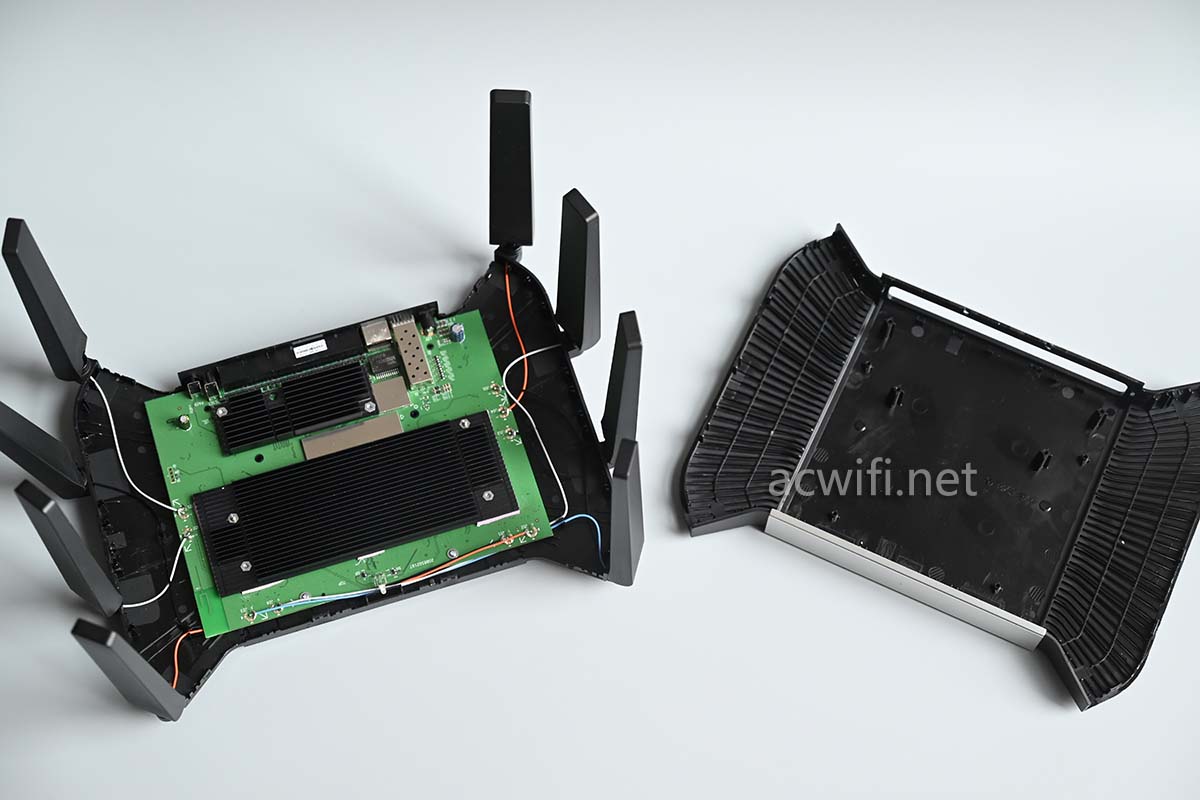
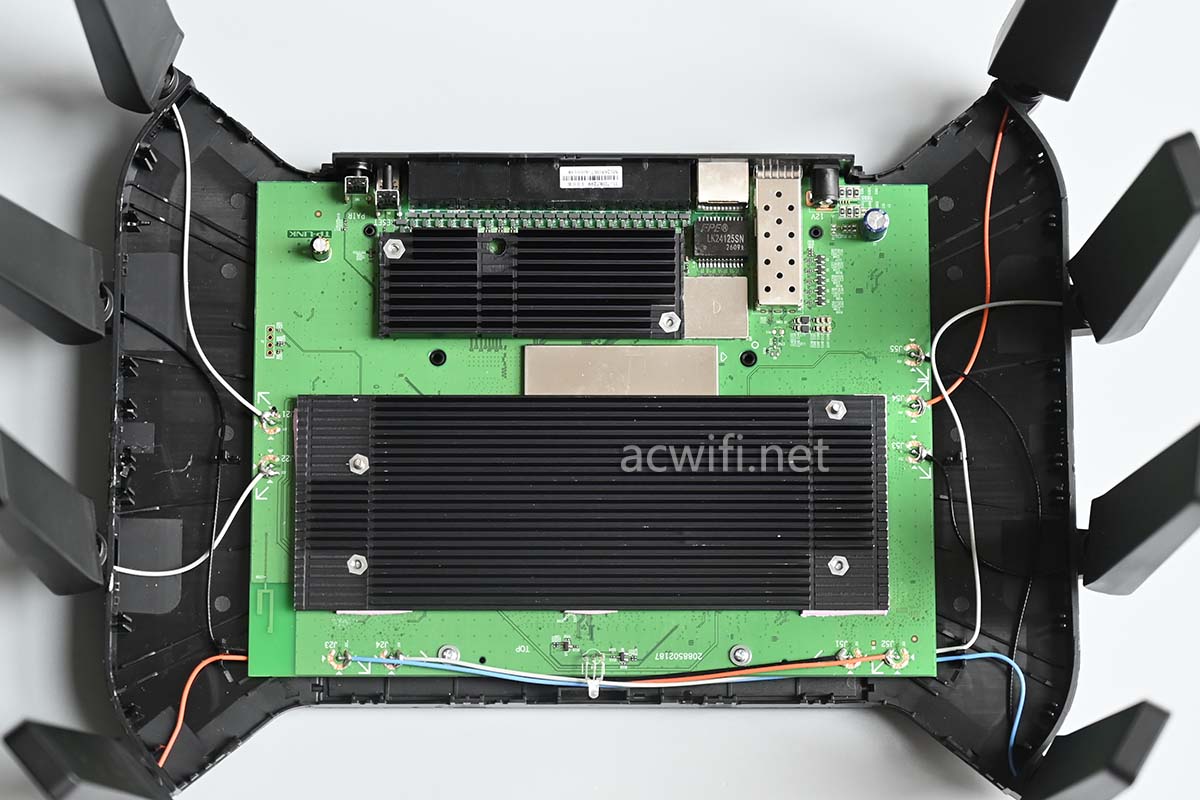
Inside, the TL-7DR7299 PCB is noticeably larger than that of the 7DR7290:
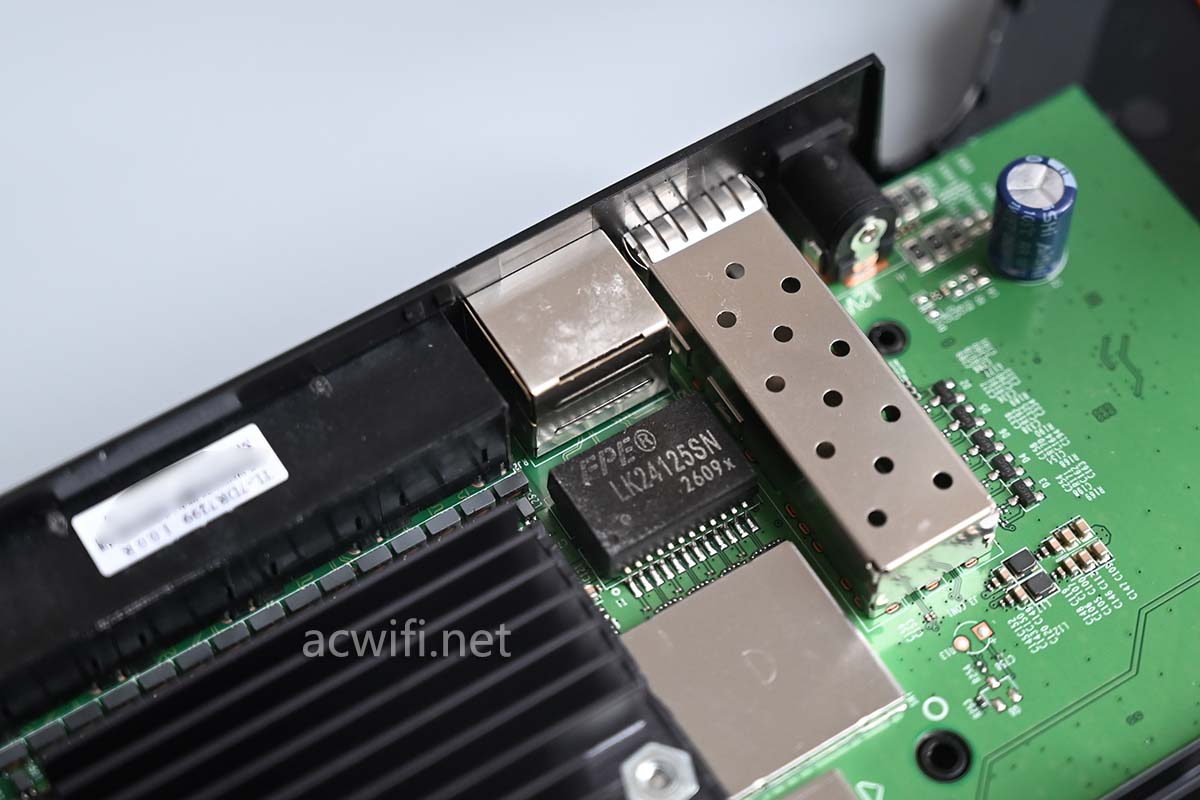
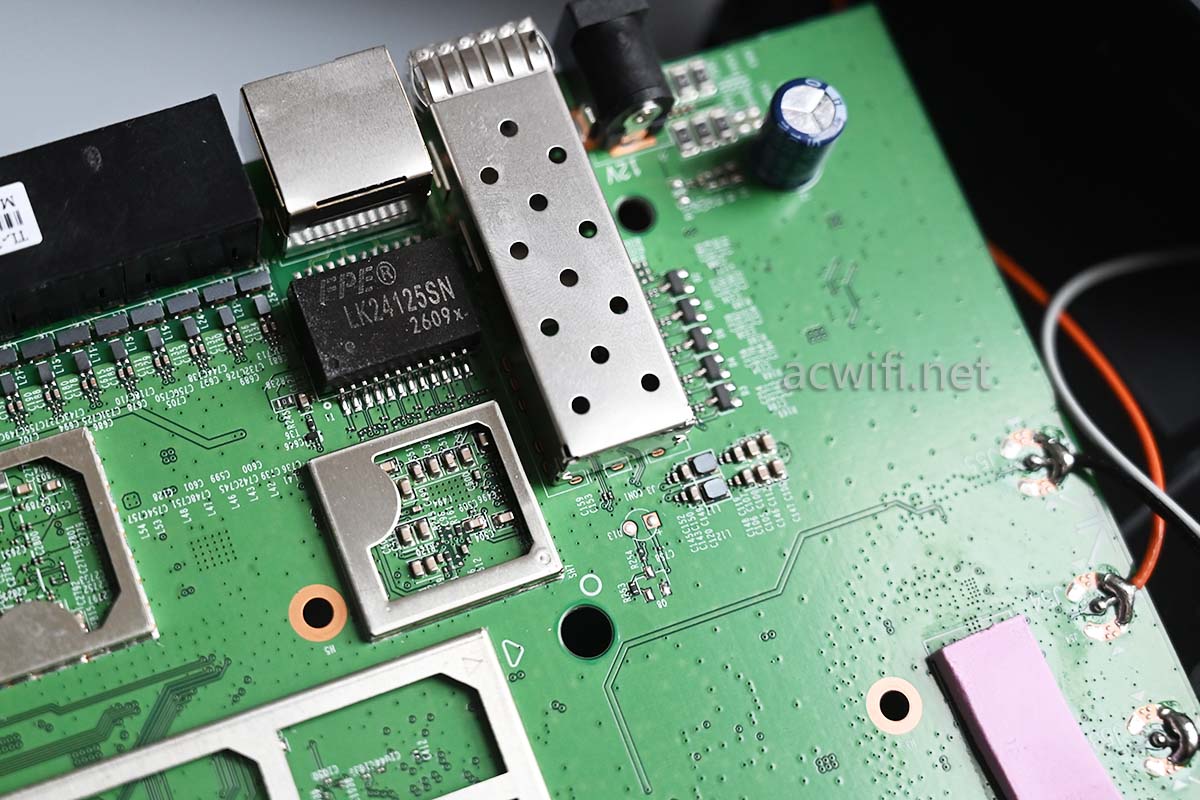
The 10G RJ45 port utilizes a Maxim LK24125SN network isolation transformer:
The RF feeder coaxial cables flanking the board are relatively short. To flip the PCB over, the 2.4GHz feeder cables must be desoldered:
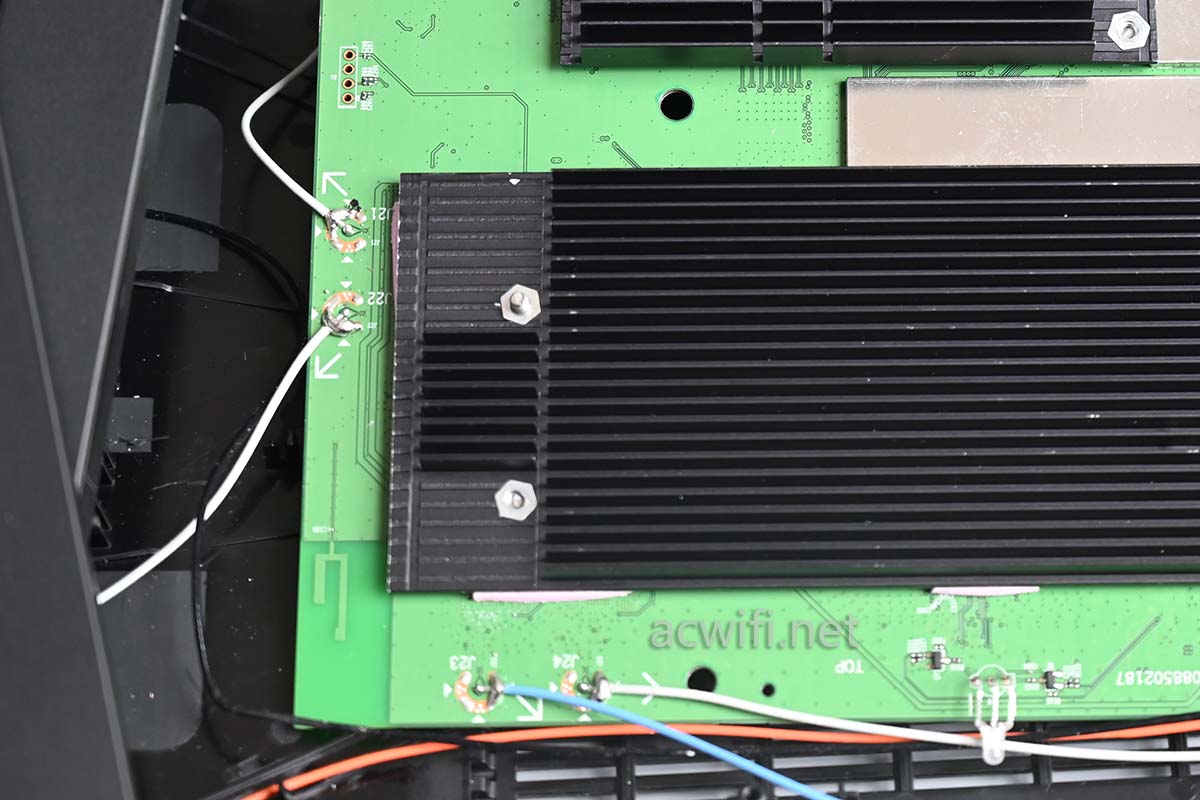
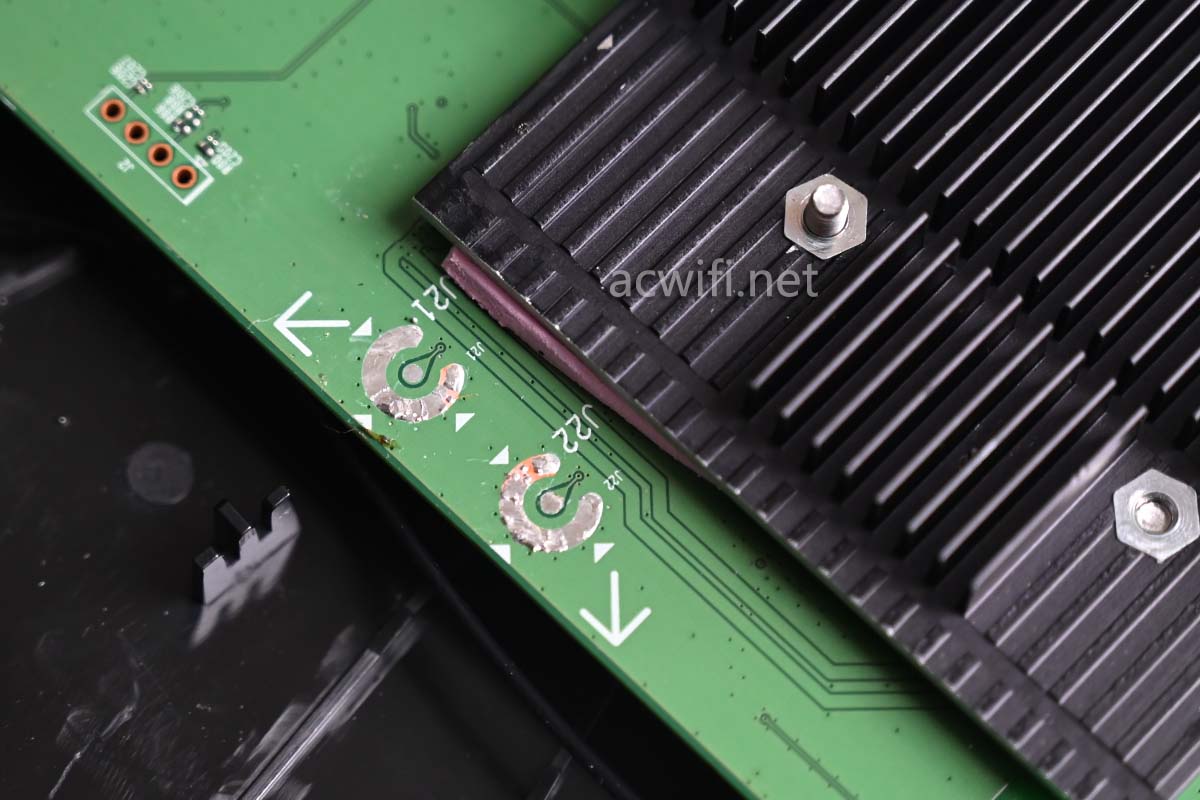
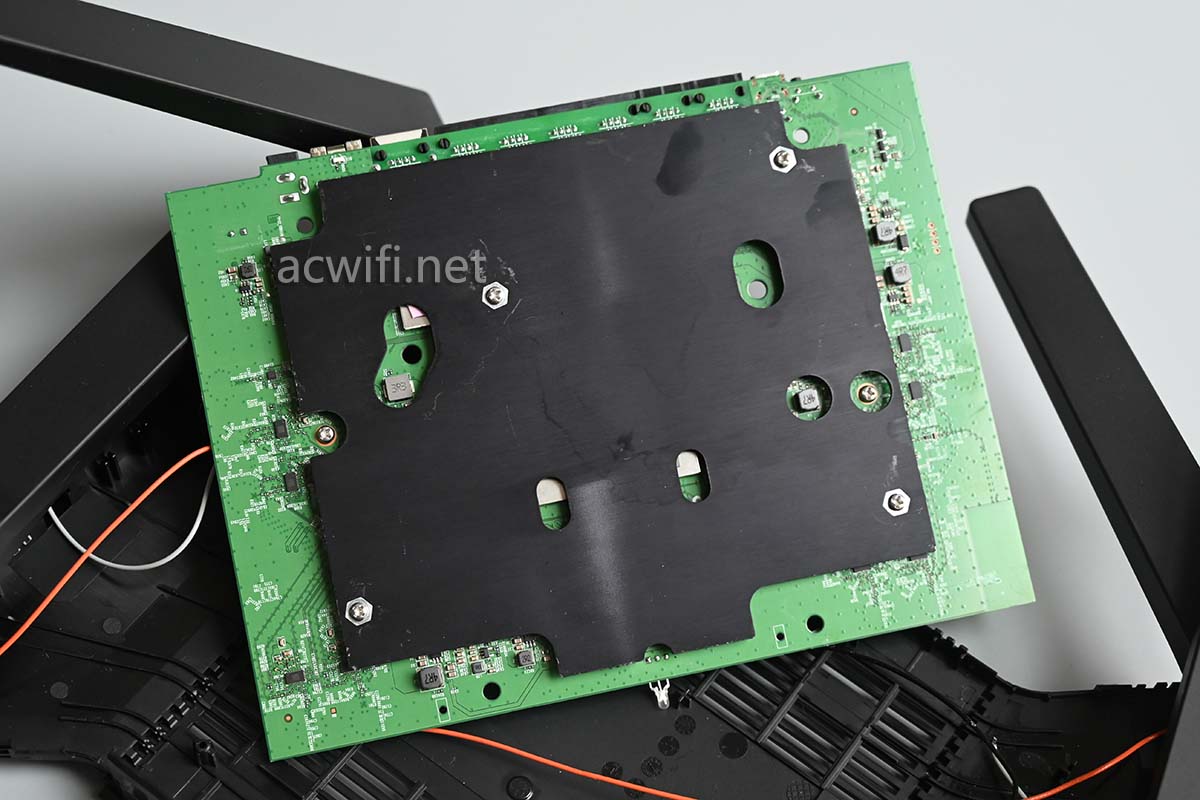
With the feeders free, the board can be fully inverted. The underside is dominated by a substantial black anodized aluminum heat spreader (larger than the plate found on the 7DR7290):
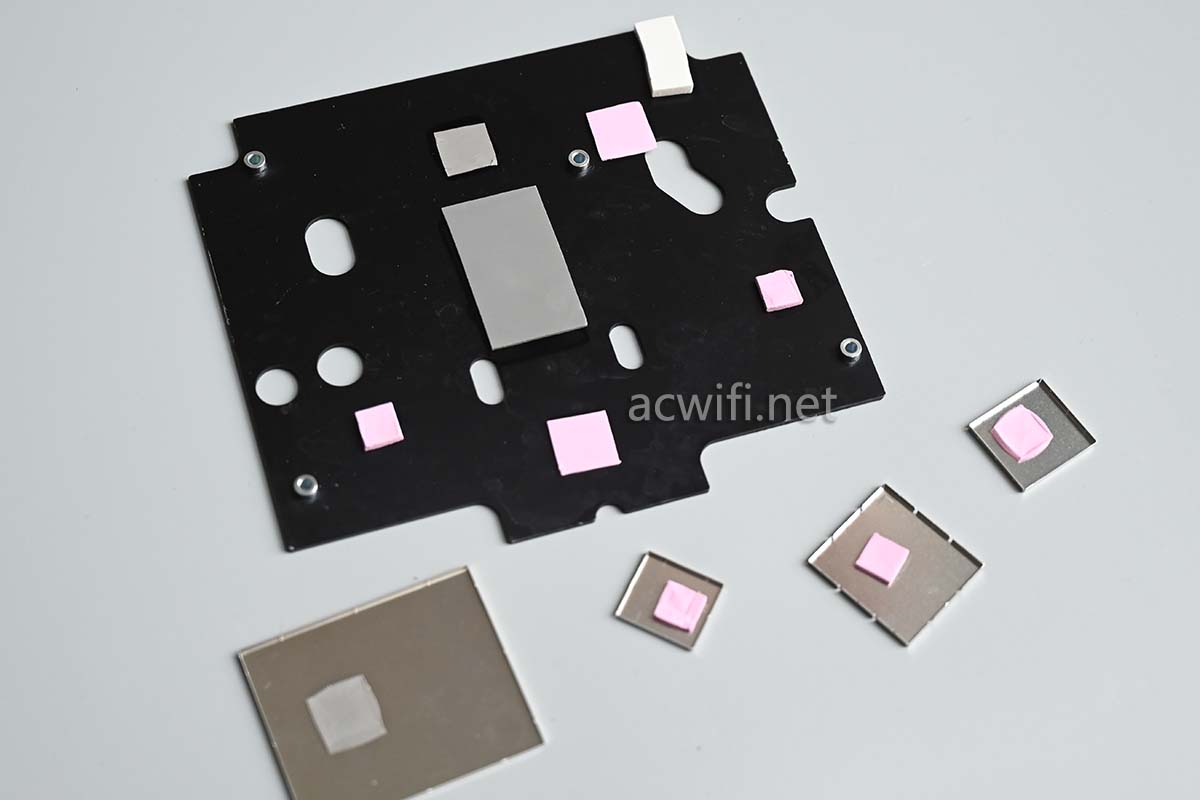
Removing the heat spreader reveals multiple high-conductivity thermal silicone pads. Notably, a dedicated thermal pad sits directly underneath the 10G SFP+ cage to wick heat away from active optical transceivers:
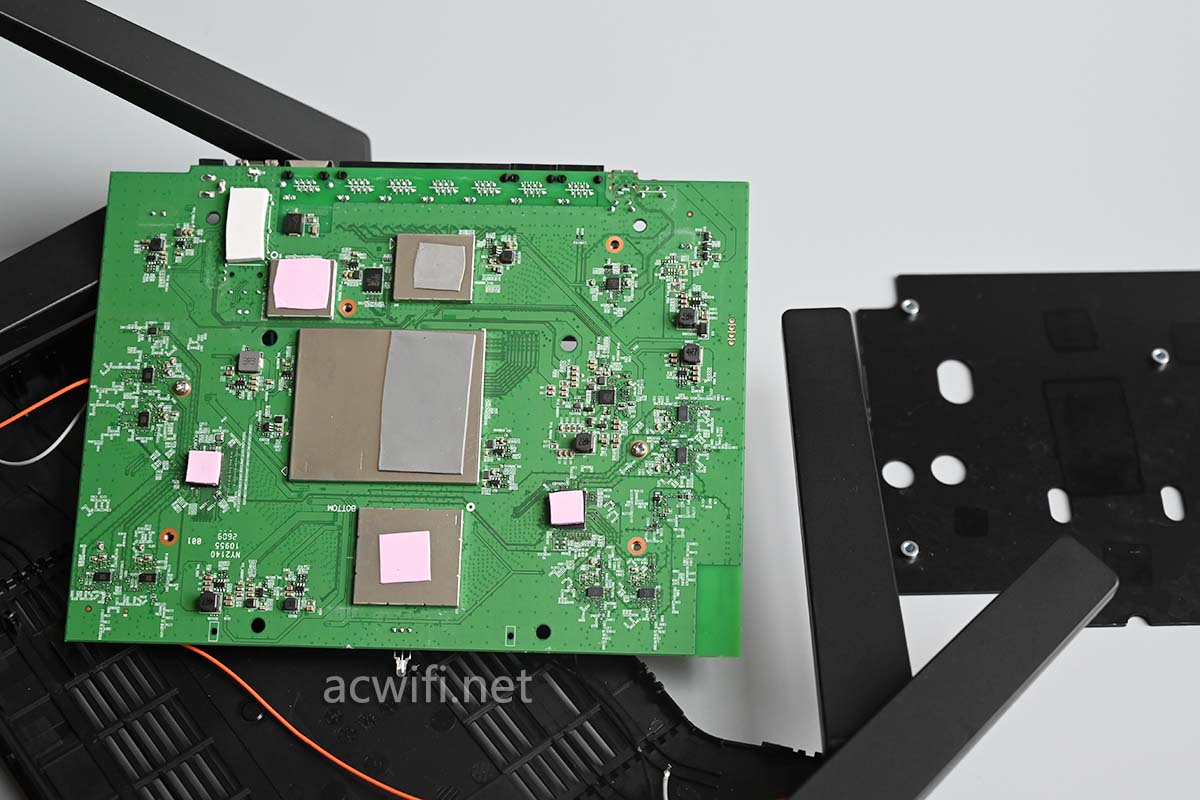
All primary processors and radio ICs are situated on this side of the PCB, sealed under EMI shielding cans:
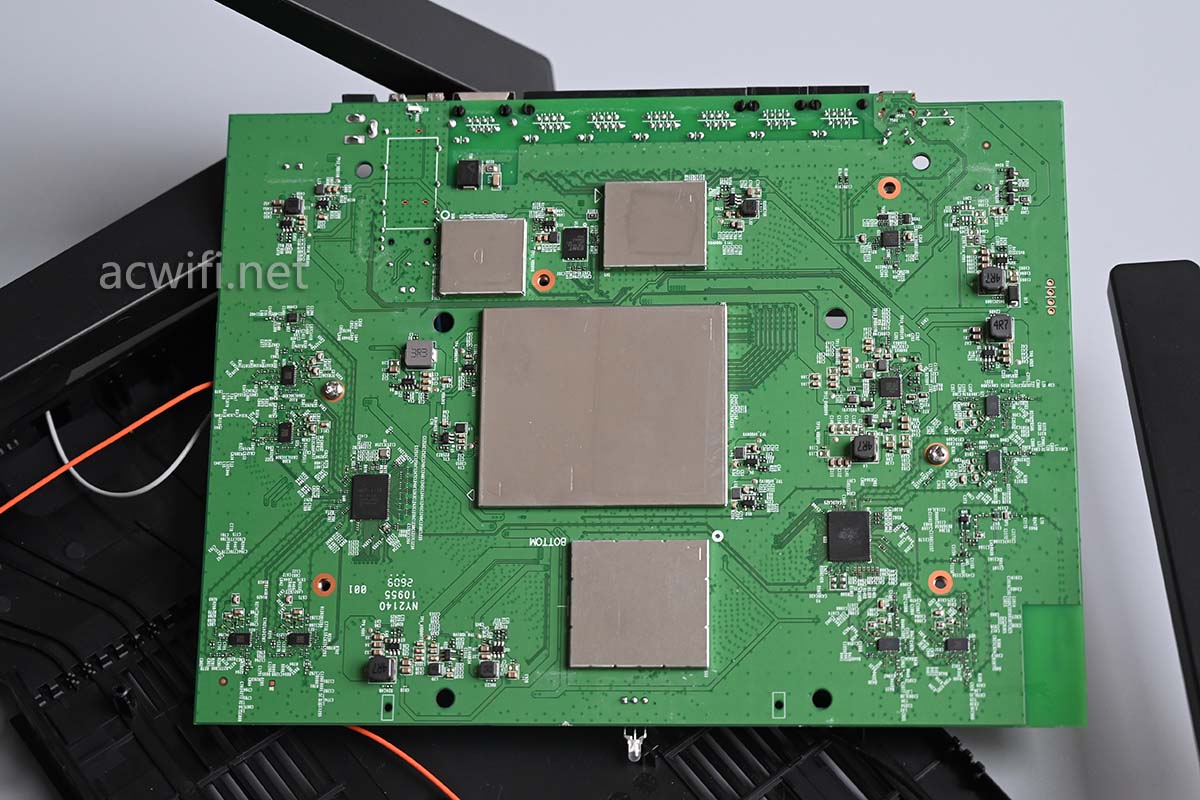
Prying off the EMI shields:
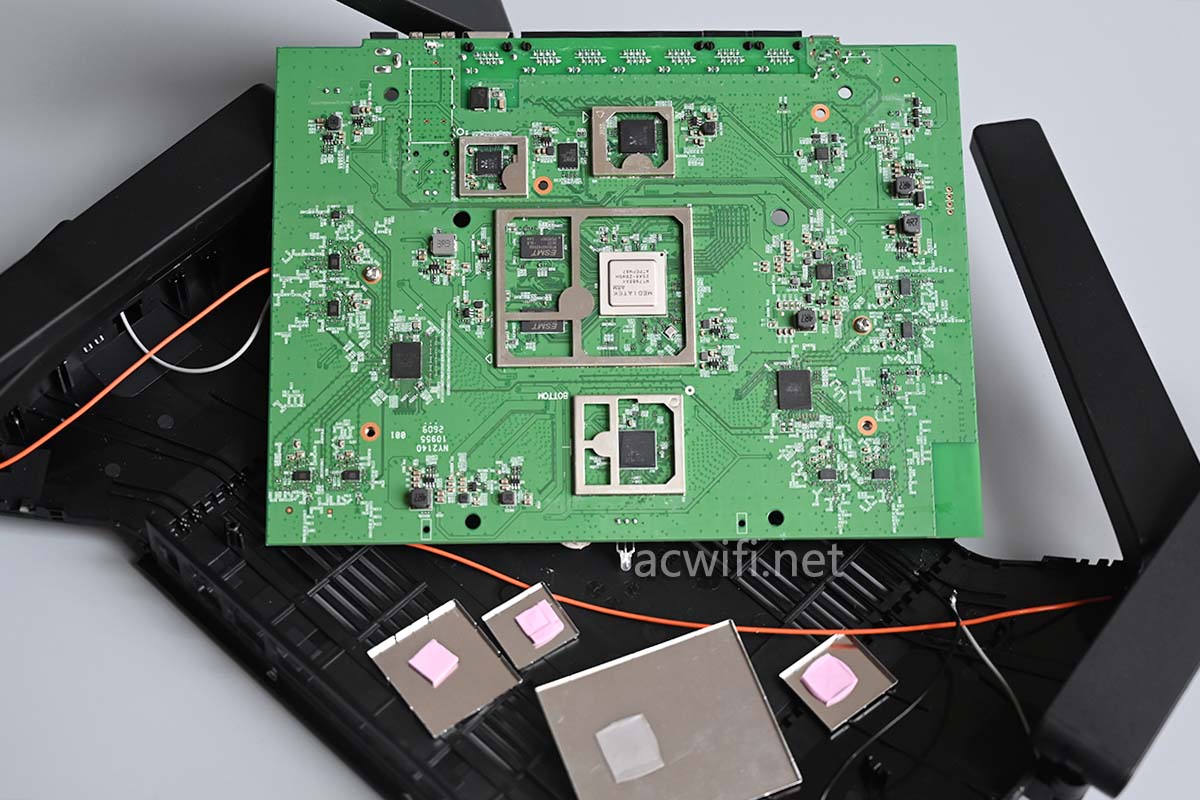
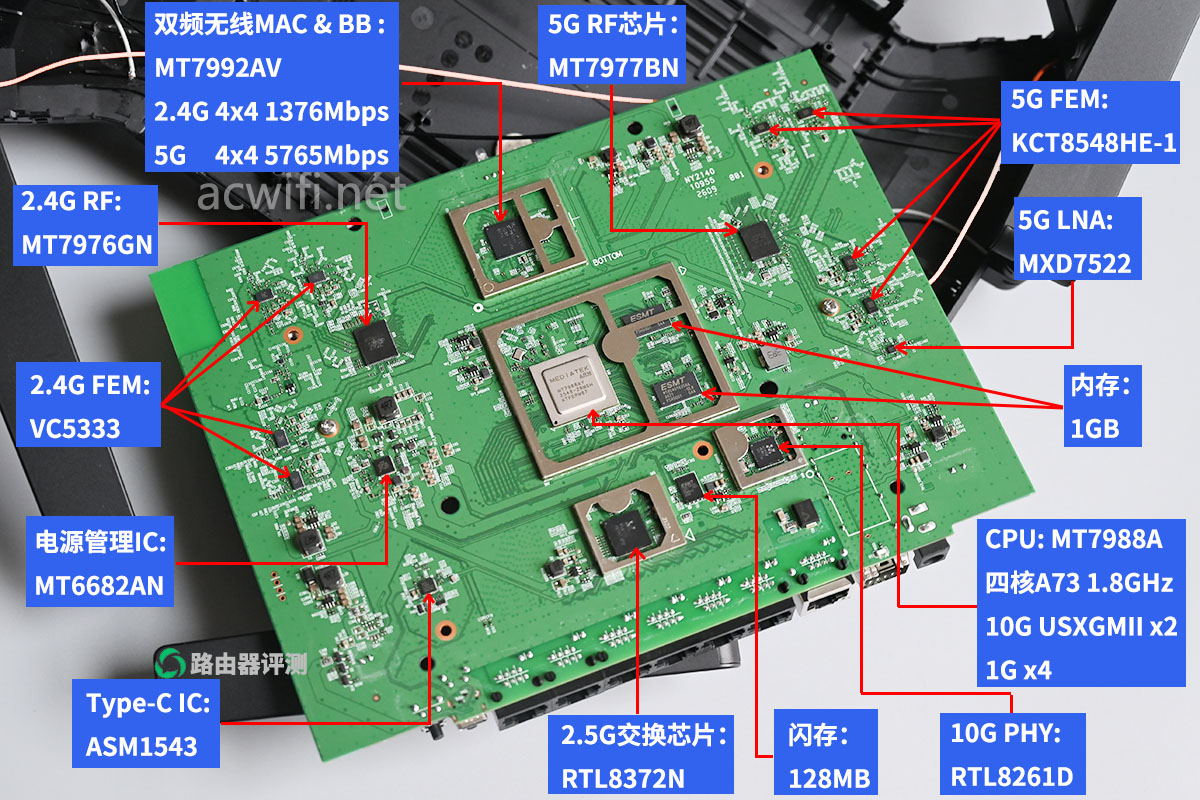
The core silicon lineup of the TP-Link TL-7DR7299 is fully exposed:
IV. Chipset & Semiconductor Architecture Breakdown
The hardware configuration delivers impressive silicon choices across CPU, switching, and radio systems:
1. Central Processor (SoC)
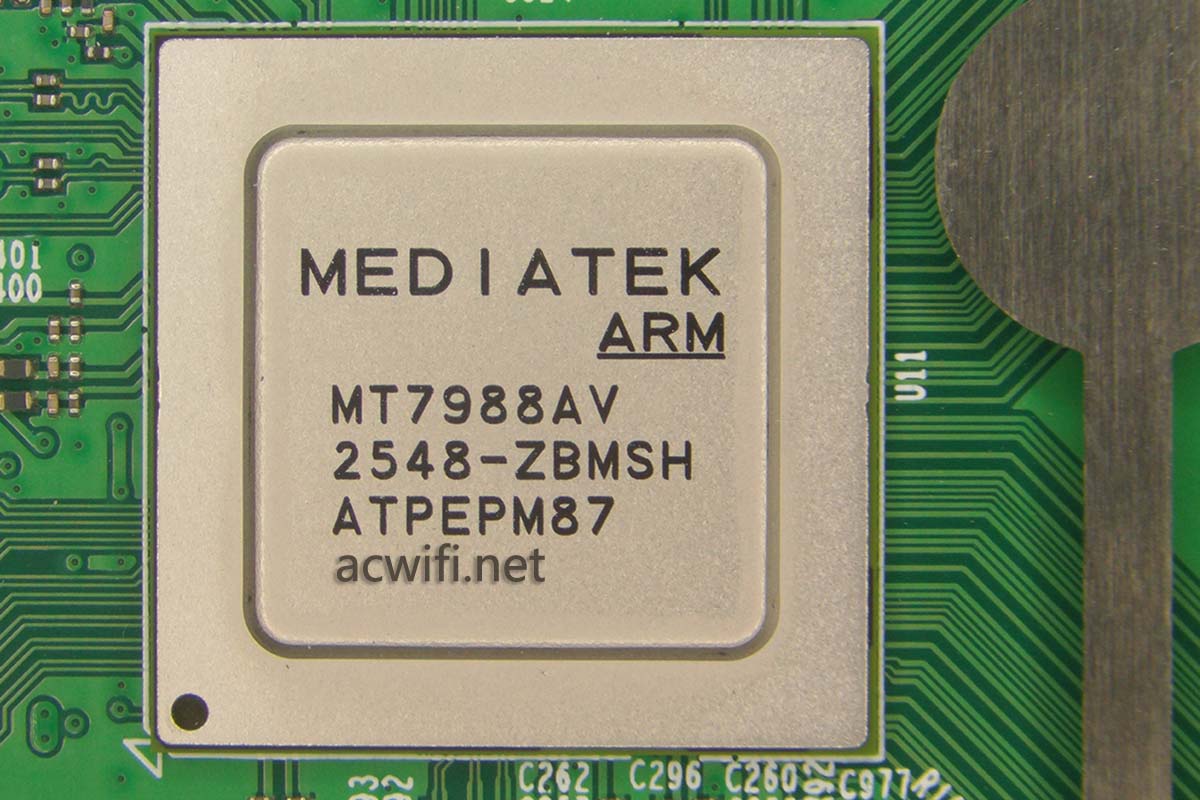
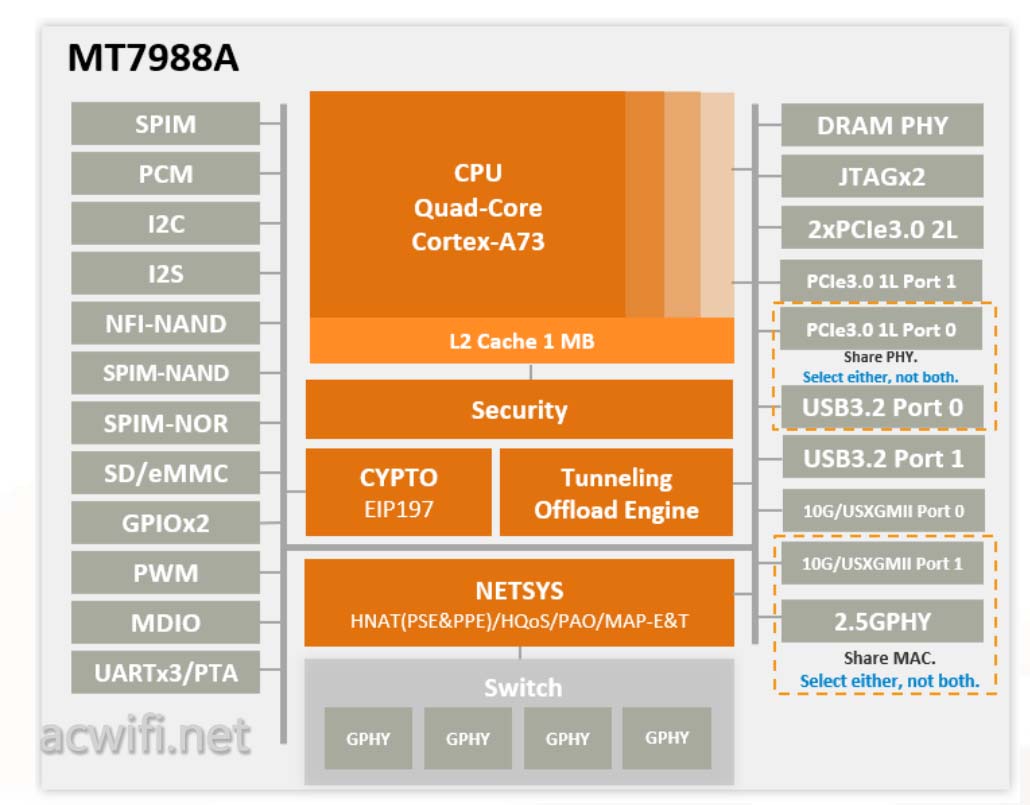
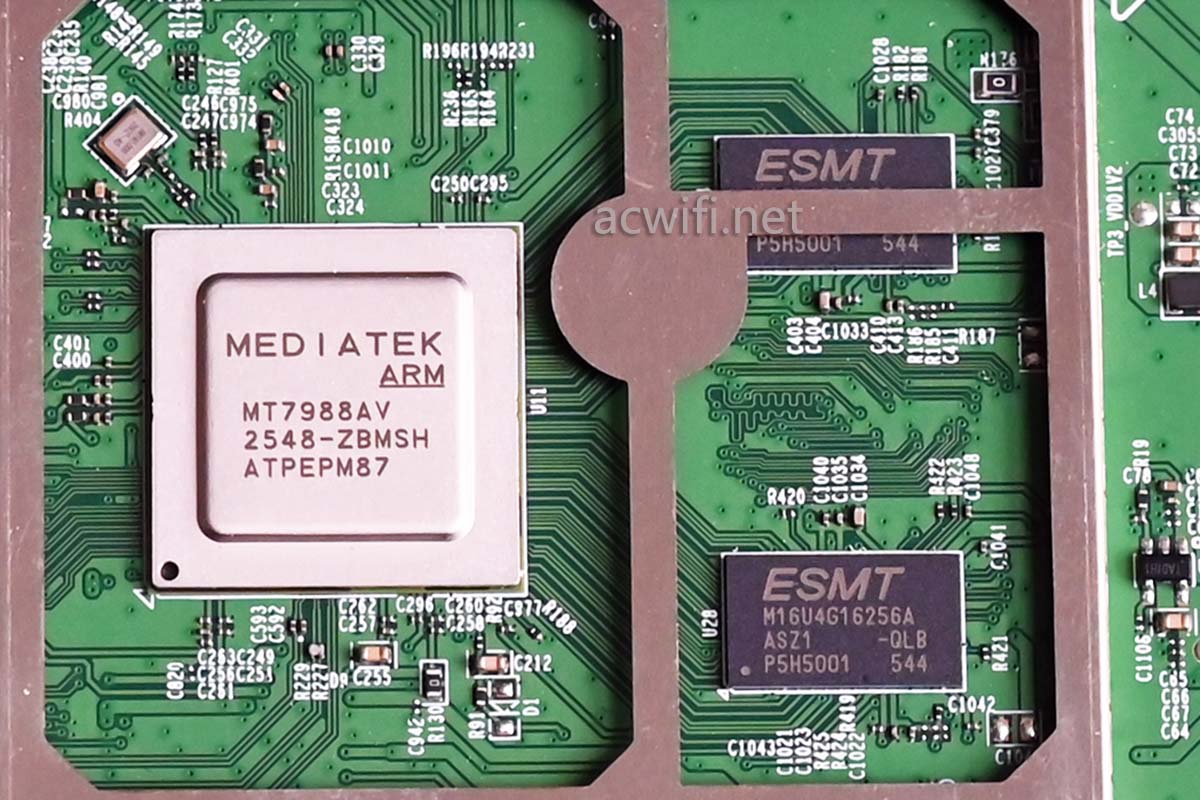
Occupying the central PCB position is the flagship MediaTek MT7988AV (commonly abbreviated as MT7988A, flagship of the Filogic 880 family):
- Architecture: 4x ARM Cortex-A73 cores, clocked up to 1.8 GHz, built on an efficient 12nm node.
- High-Speed Interconnects: Features dual 10G USXGMII interfaces (with one lane sharing a MAC with a 2.5G PHY).
- Supports high-throughput peripheral interconnect via USB 3.2.
- Integrates an internal 4-port Gigabit Ethernet switch engine.
Functional block diagram of the MediaTek MT7988AV SoC:
2. System Memory (RAM)
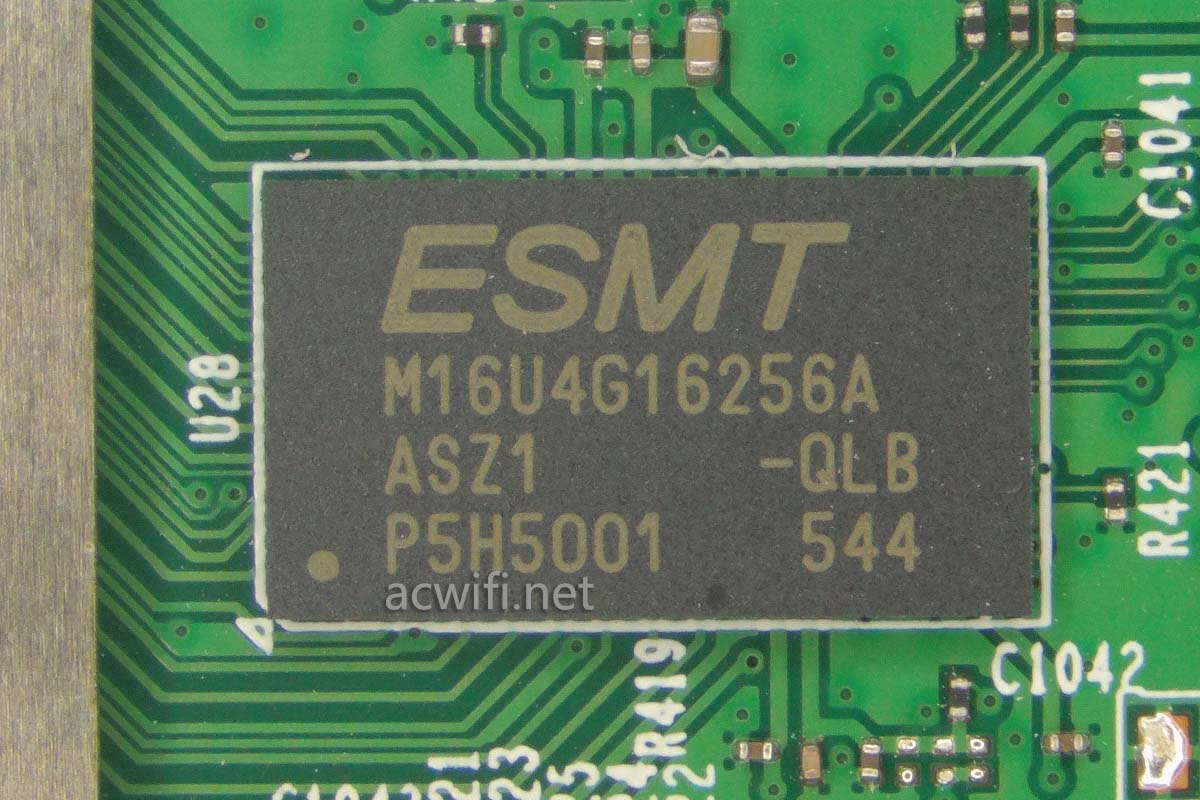
Flanking the CPU are two DDR4 memory packages from EtronTech, part number M16U4G16256A-QLBG:
- Bus Specification: DDR4-3200.
- Density: 512 MB per chip.
- Combined memory capacity: 1 GB (1024 MB), offering massive buffer capacity for demanding routing, NAT tables, and OpenWrt package stacks.
Detailed view of the SoC and RAM section:
3. Multi-Gigabit Switching & 10G PHY
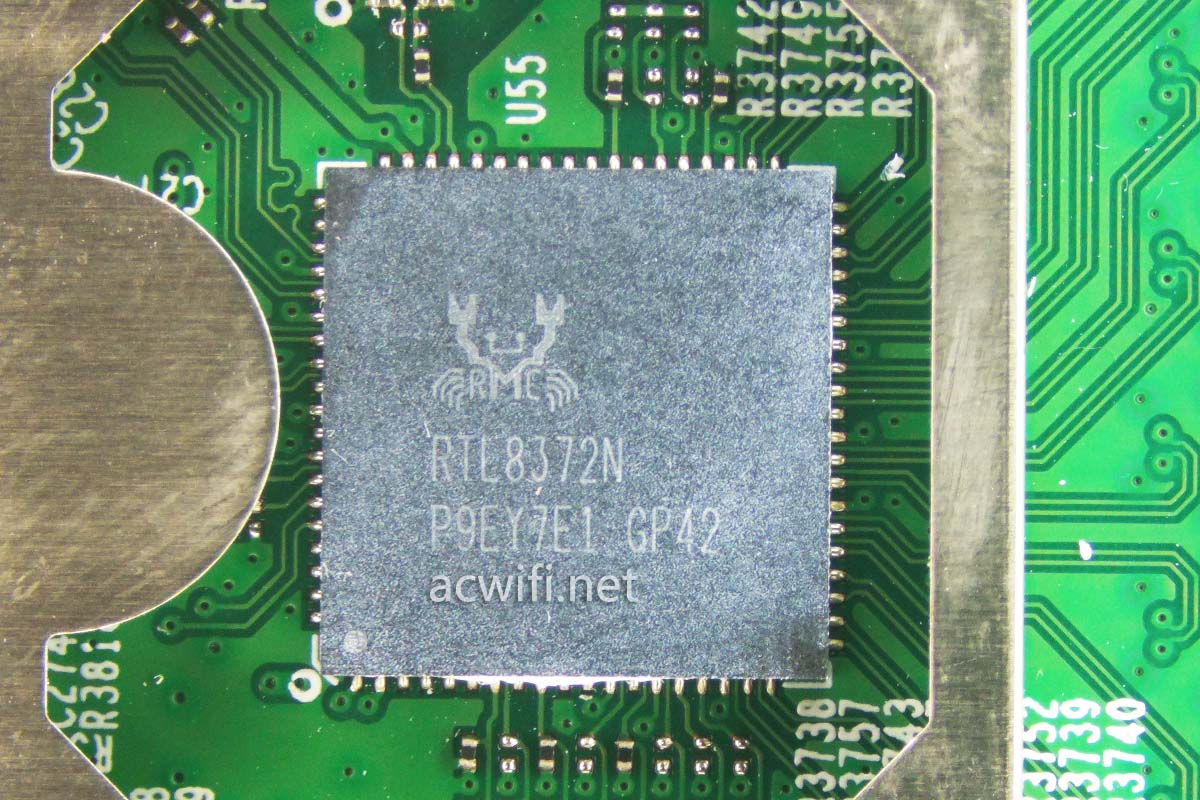
The multi-gigabit Ethernet plumbing is driven by Realtek silicon:
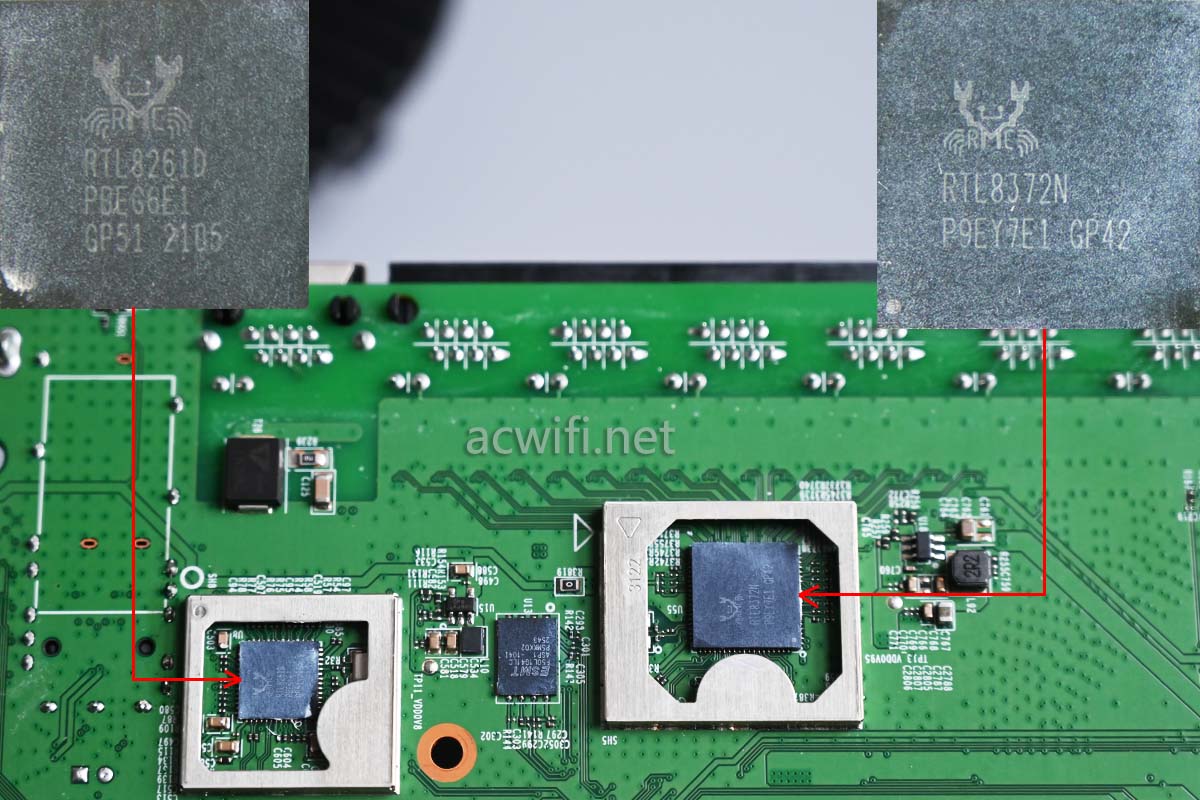
- 2.5G Switch IC: Realtek RTL8372N. It provides two 10G USXGMII links (one dedicated to the 10G SFP+ cage, the other linking directly into the MT7988A SoC). Internally, the RTL8372N houses four integrated 2.5G PHYs driving the four 2.5GbE LAN/WAN ports.
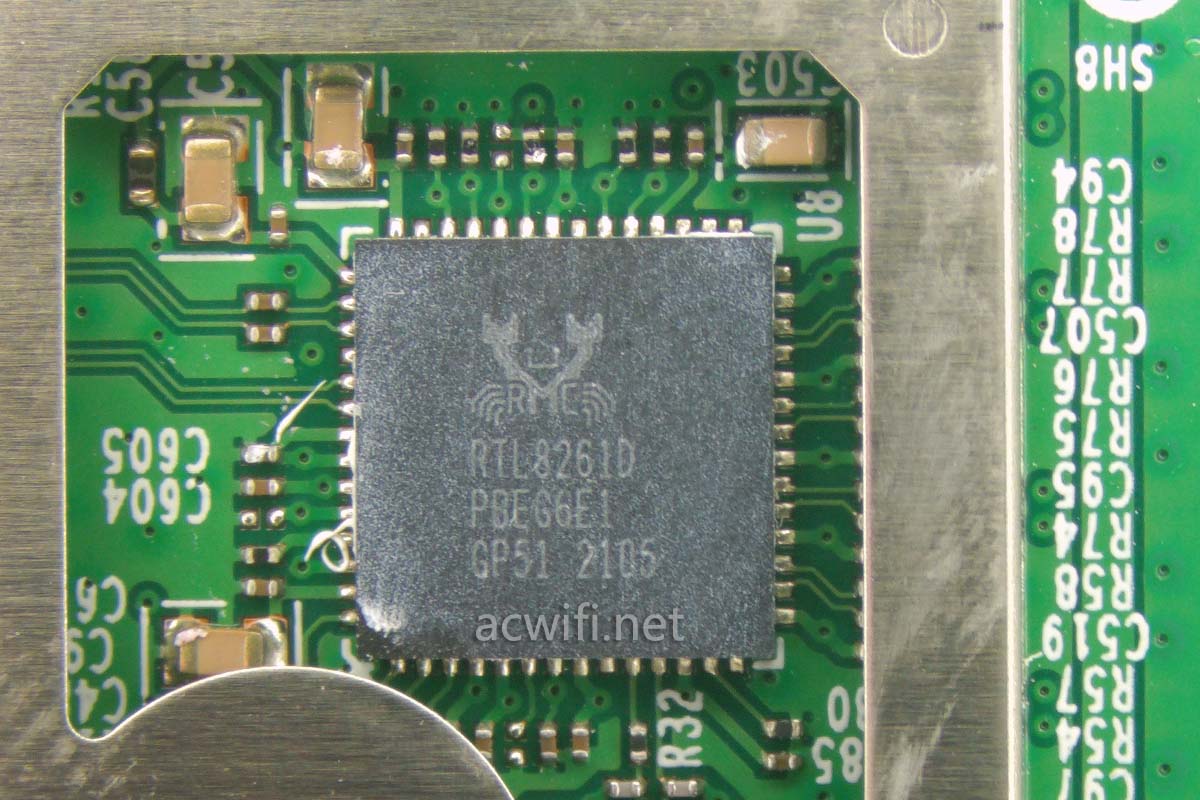
- 10G Copper PHY: The 10G RJ45 port relies on a dedicated Realtek RTL8261D multi-gigabit PHY. It auto-negotiates across five discrete speeds: 100M, 1G, 2.5G, 5G, and 10G Ethernet.
Silicon placement of the network controller chips:
4. Flash Storage
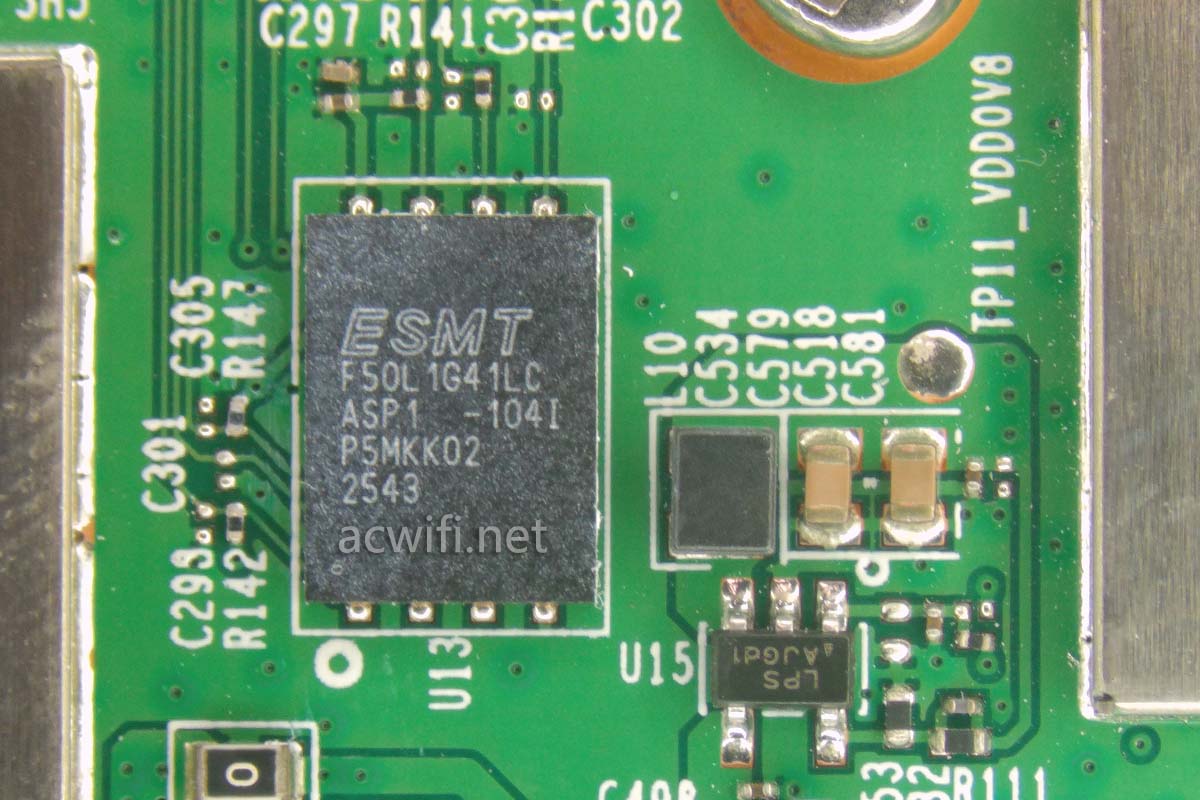
Positioned between the networking ICs is an SPI NAND flash chip, part number F50L1G41LC, providing 128 MB of non-volatile storage:
5. Wi-Fi Baseband & MAC Processor
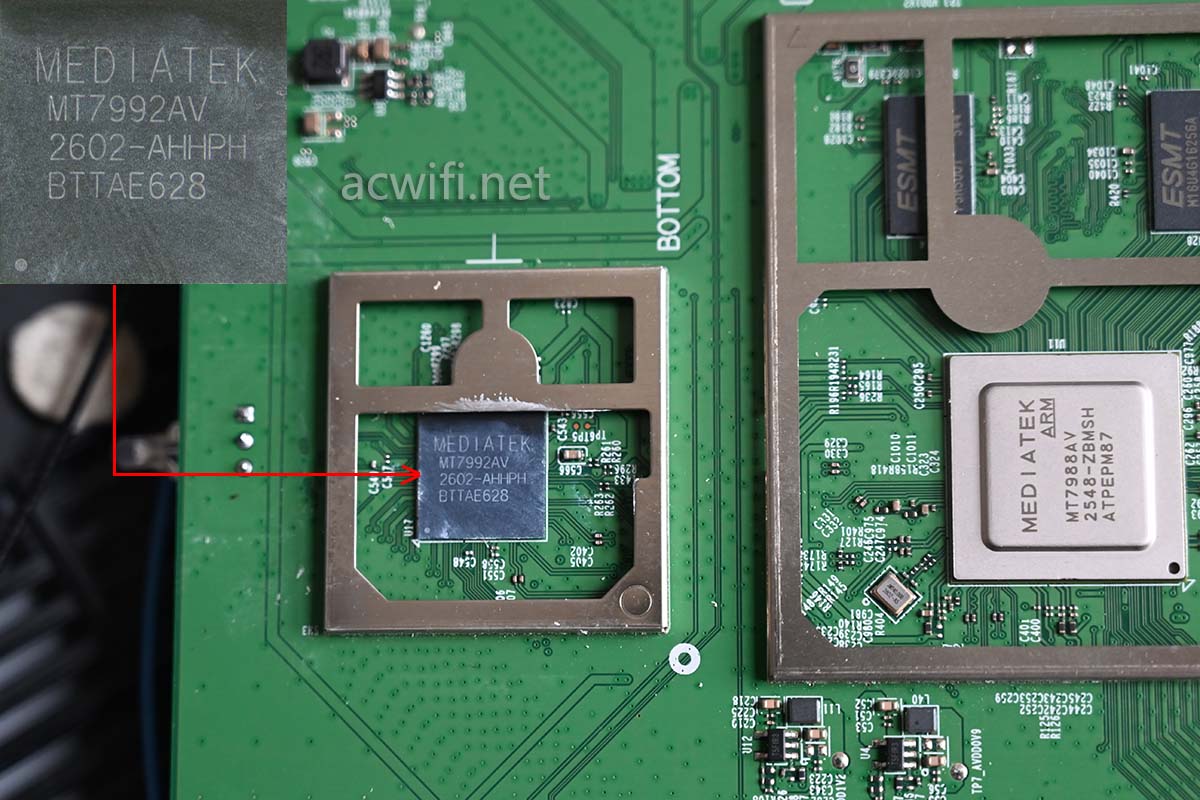
Baseband and wireless MAC duties are handled by the MediaTek MT7992A processor (interfaced directly to the MT7988A CPU, manufactured on an advanced 6nm process):
- Full Wi-Fi 7 feature set on both 2.4GHz and 5GHz with 4x4 MIMO.
- 2.4 GHz: Up to 1376 Mbps theoretical PHY rate (40MHz channel, 4096-QAM).
- 5 GHz: Up to 5765 Mbps theoretical PHY rate (160MHz channel, 4096-QAM).
- Combined wireless bandwidth hits the BE7200 speed rating (1376 + 5765 ≈ 7141 Mbps).
6. 2.4GHz RF Transceiver & External FEMs
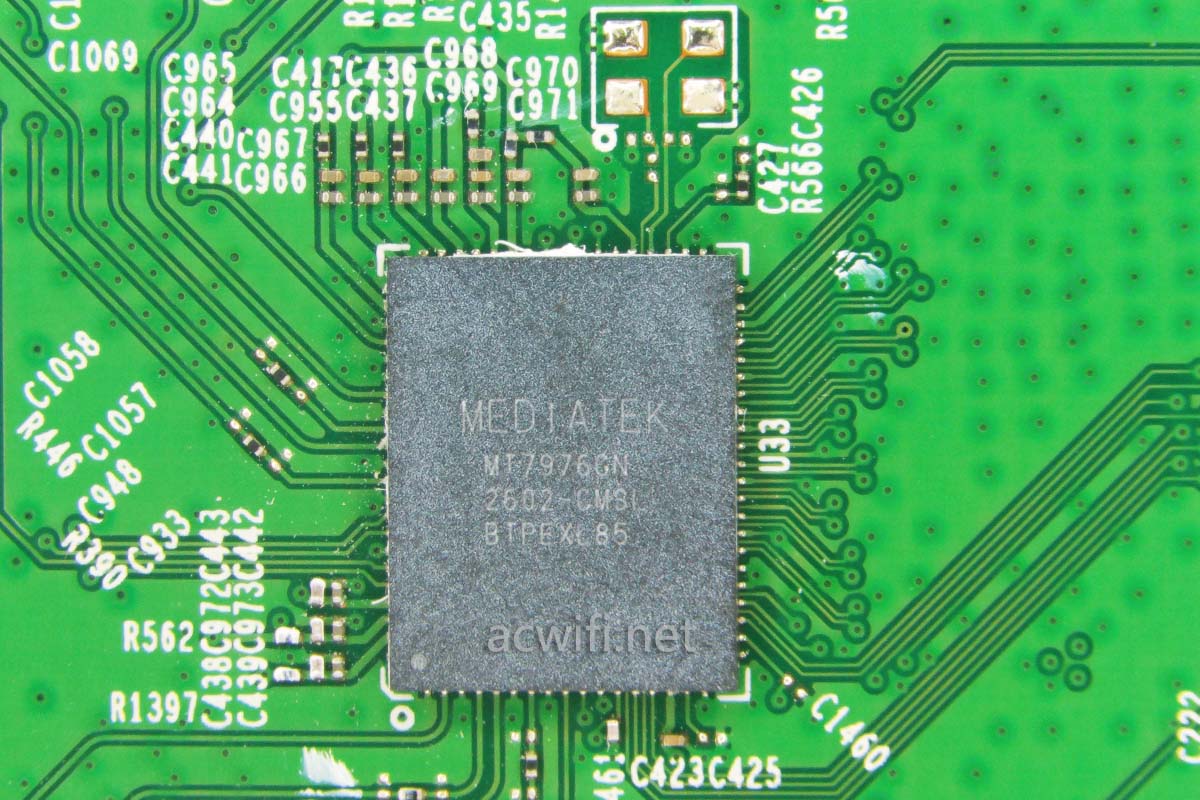
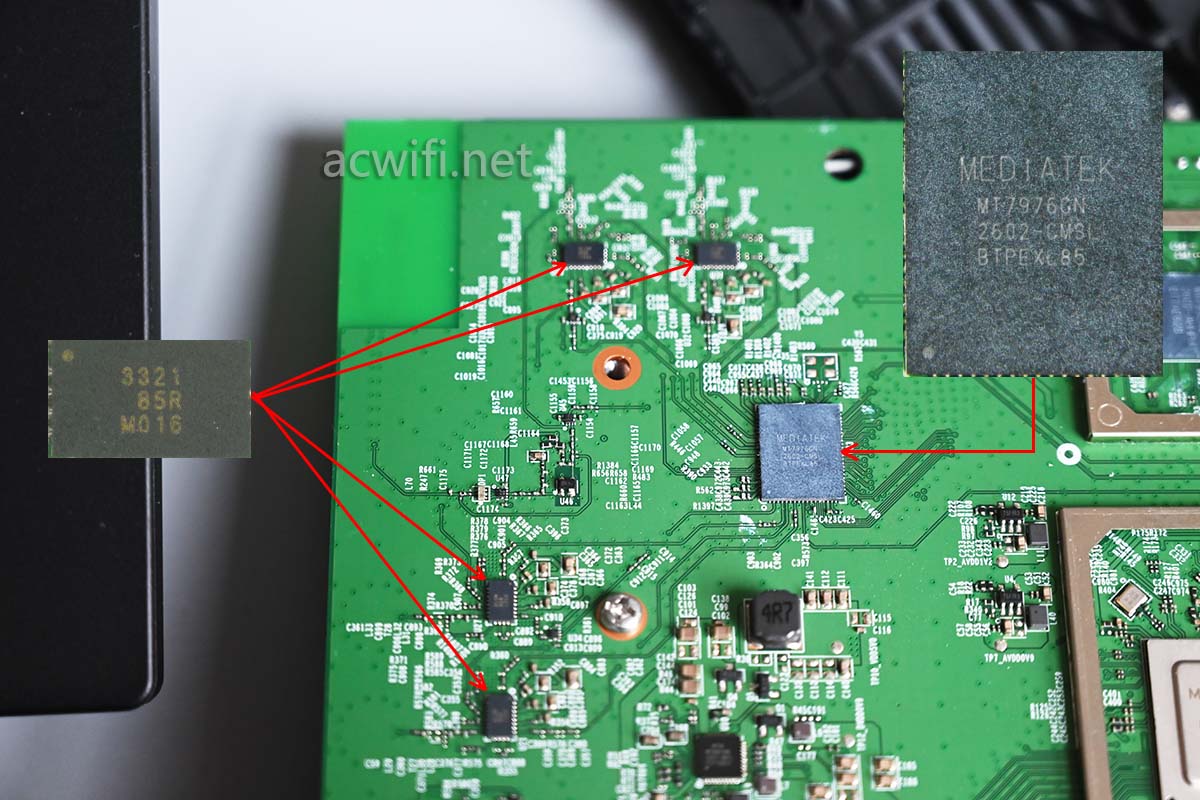
- 2.4GHz RF IC: MediaTek MT7976GN (the “G” suffix denotes an RF transceiver without built-in internal power amplifiers, requiring external front-end modules), operating in 4T4R:
- 2.4GHz Front-End Modules (FEM): Four external high-power FEMs from Vanchip, model VC5333-21 (or simply VC5333):
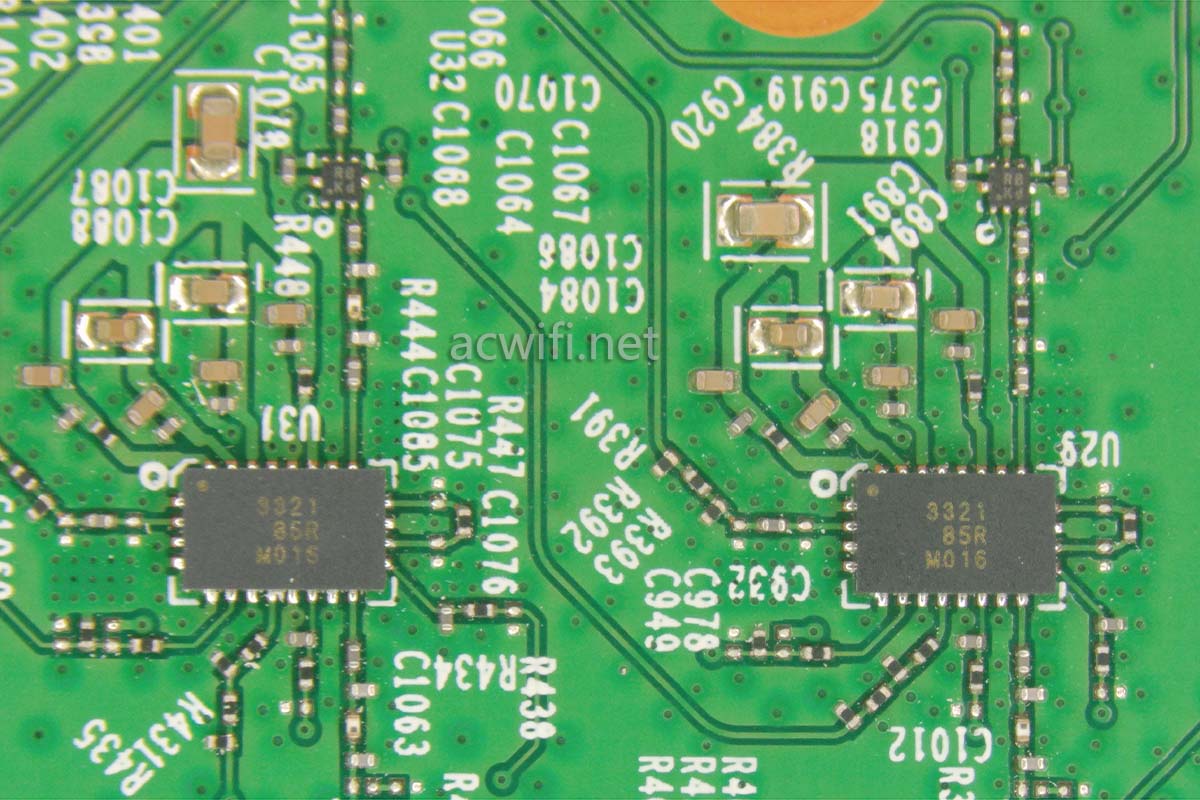
VC5333-21 RF specifications:
- Frequency range: 2.4 GHz – 2.5 GHz.
- Linear output power: 19 dBm @ IEEE 802.11ax MCS11 HE40, EVM < -43 dB (5V rail).
- Linear output power: 23 dBm @ IEEE 802.11n MCS7 VHT40, EVM < -30 dB (5V rail).
- Transmit gain: 34 dB.
- Receive gain: 14 dB.
7. 5GHz RF Transceiver & High-Power FEM Array
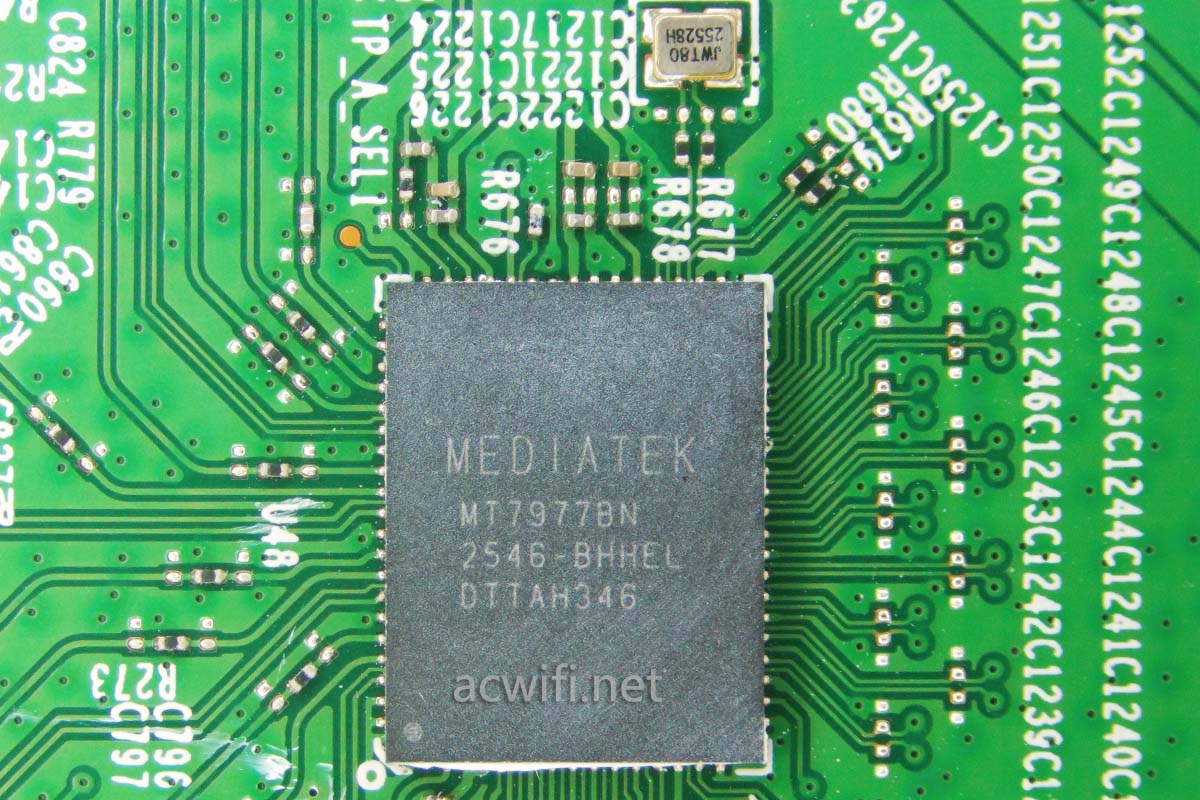
- 5GHz RF IC: MediaTek MT7977BN (external FEM variant), running in a 4T5R (4 Transmit, 5 Receive) topology:
- 5GHz High-Power FEMs: Four high-power Front-End Modules from GrandChip/Kangxi Telecom, model KCT8548HE-1 (a higher-output revision compared to the standard KCT8548HE on the 7DR7290).
- 5th Path Low-Noise Amplifier (LNA): Because the 5GHz chain uses a fifth dedicated receive path (5R), an external standalone LNA chip is added: the Maxscend MXD7522:
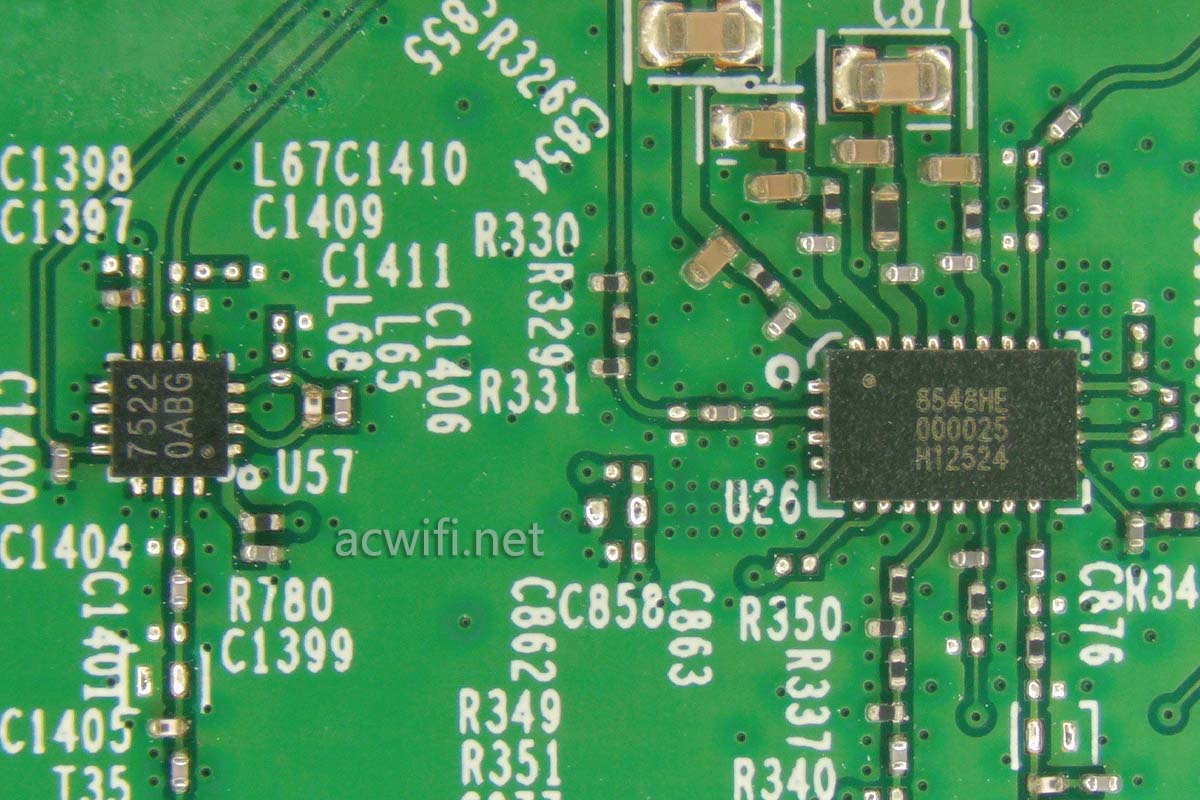
KCT8548HE-1 power output ratings:
- Integrated 5GHz PA, LNA with bypass, and T/R switch.
- Transmit gain: 30.5 dB @ 5V.
- Receive gain: 16.5 dB @ 5V.
- Noise figure: 1.8 dB @ 5V.
- Output power figures:
+19.5 dBm @ -43 dB HE160, MCS11 DEVM, 5V+22 dBm @ -40 dB HE160, MCS11 DEVM, 5V+24 dBm @ -35 dB VHT80, MCS9 DEVM, 5V+25 dBm @ -30 dB HT20, MCS7 DEVM, 5V
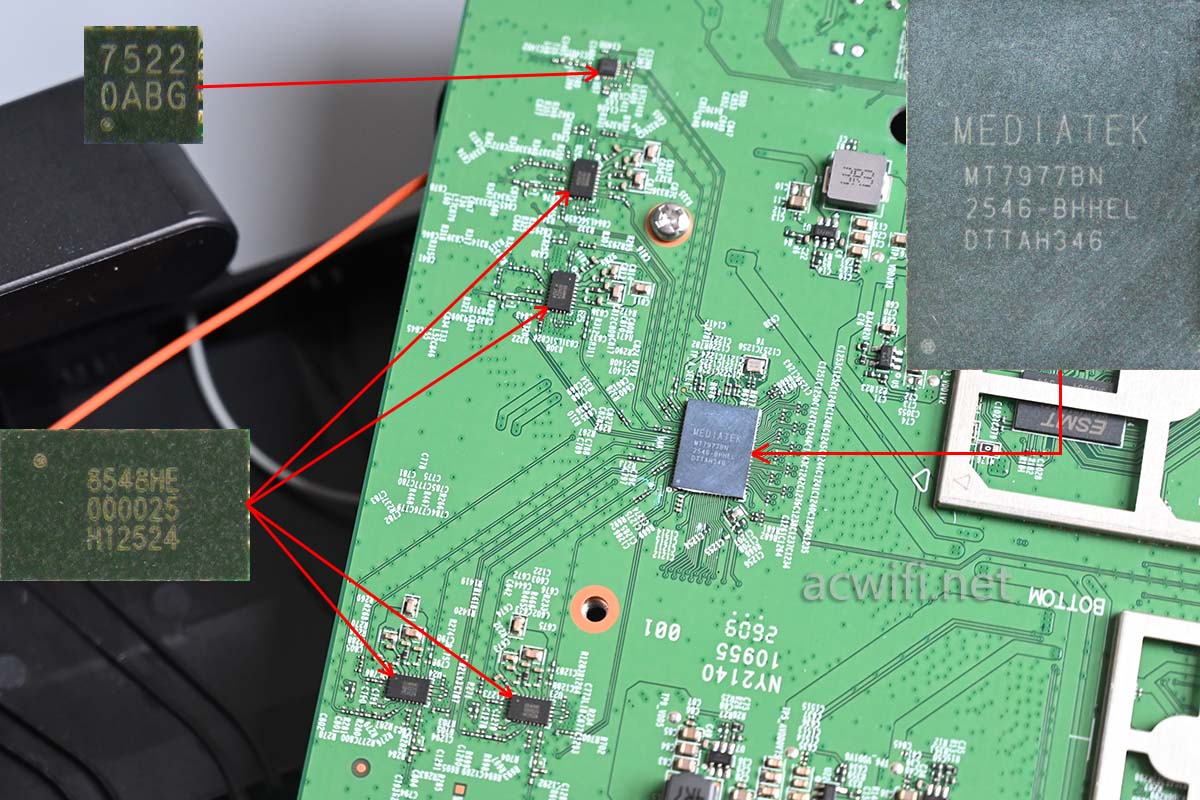
8. Peripheral ICs
- Power Management IC (PMIC): MediaTek MT6682AN, handling multi-phase DC regulation and voltage step-down sequencing across the SoC and radios:
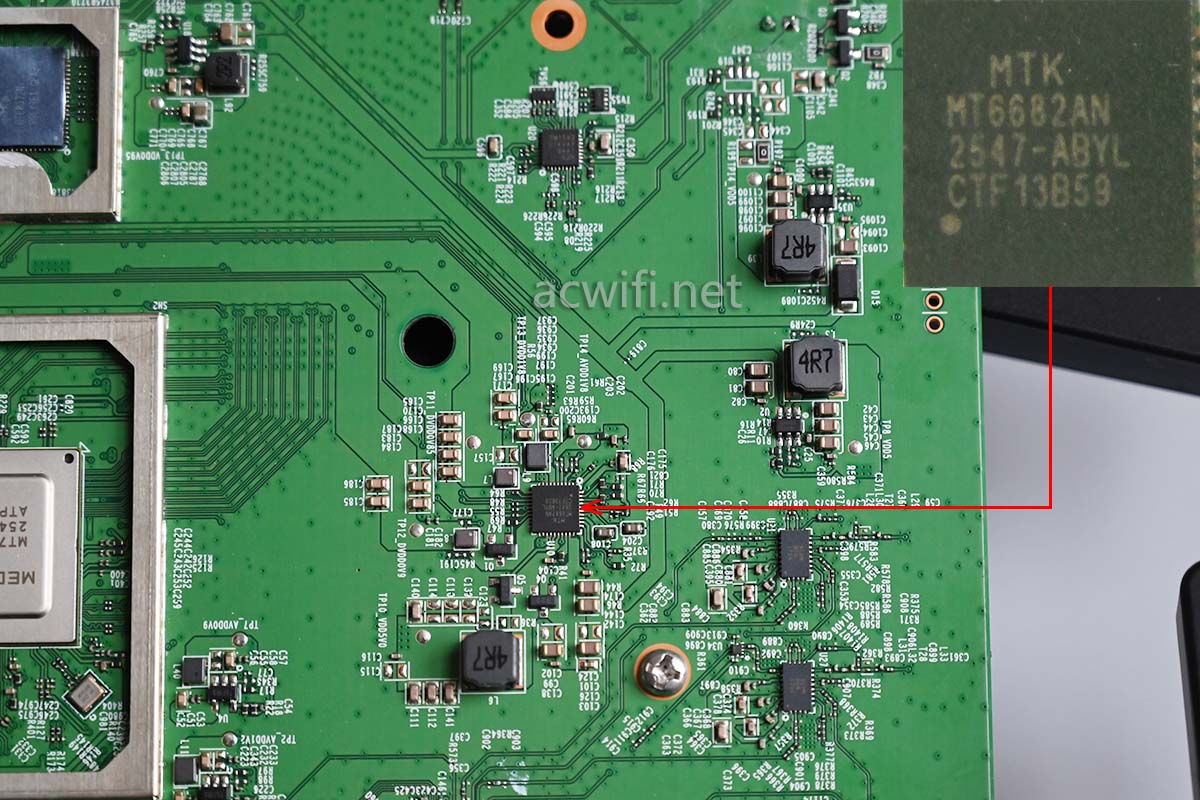
- Type-C Multiplexer Switch: ASMedia ASM1543, driving the USB Type-C interface at up to 10 Gbps:
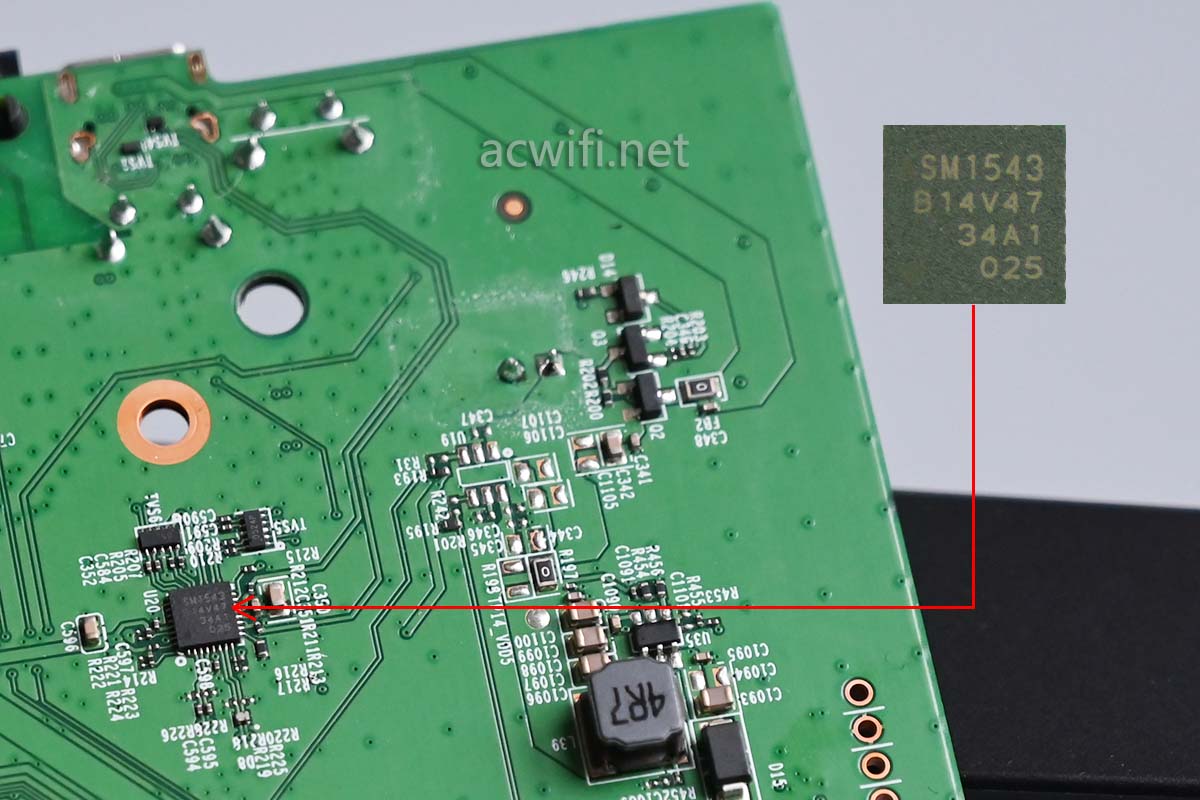
V. Top-Side Heatsinks & Assembly Reversal
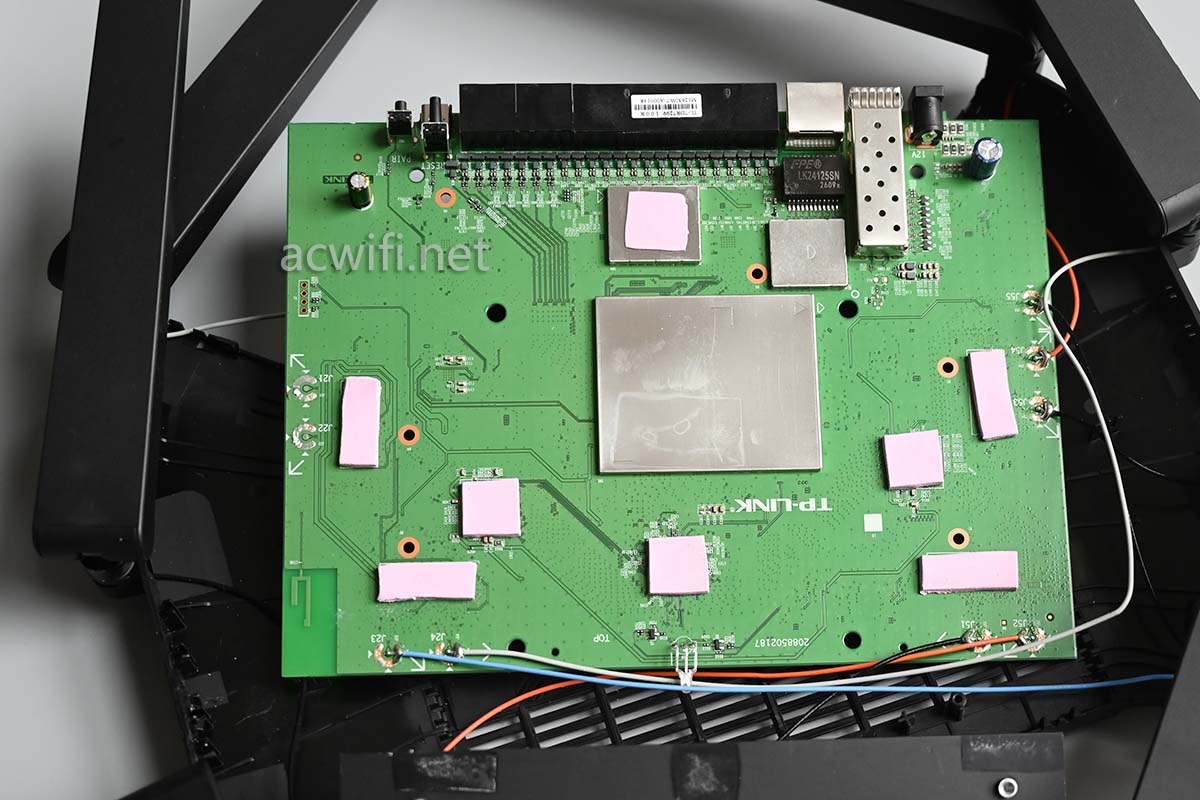
Flipping back to the top surface of the PCB reveals two extruded aluminum heatsinks. Once unscrewed, a generous array of thermal pads transfers heat from the rear of the radio, switch, and FEM zones to these radiators:
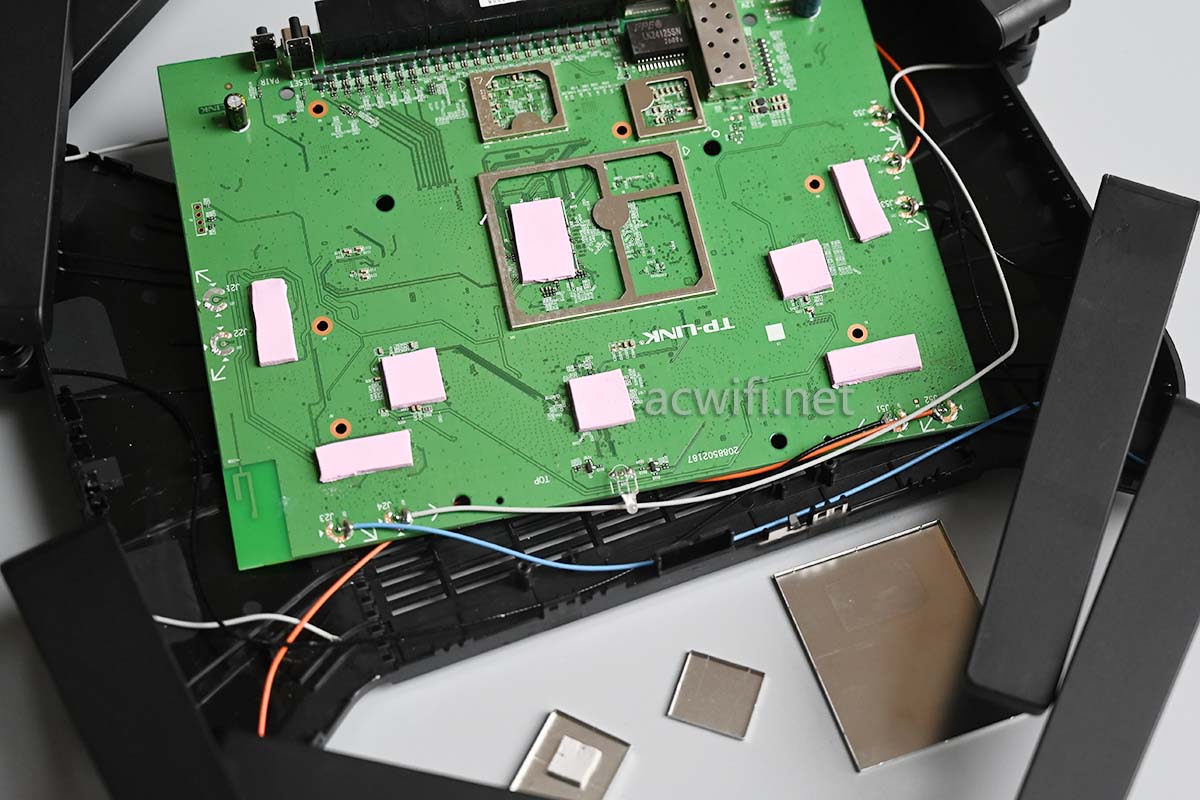
Popping off the top-side shielding covers reveals only passive routing and thermal ground pads; no active silicon resides on this face:
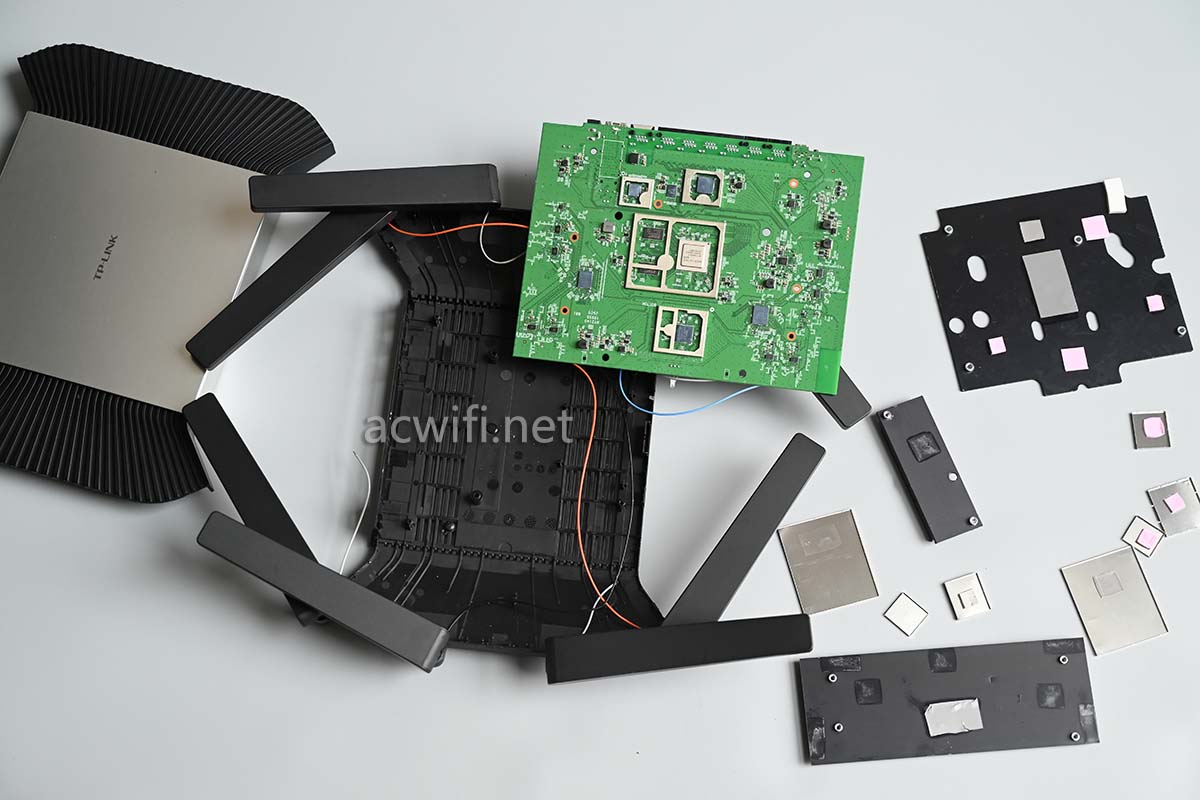
With analysis complete, the 2.4GHz coaxial antenna feeders are resoldered back into place:
Here is the comprehensive component map of the TP-Link TL-7DR7299:
VI. Real-World Benchmarking & Wireless Performance
1. 64-Byte Small Packet Forwarding
Using PacketMaster hardware traffic generators to evaluate small 64-byte packet forwarding:
- Simultaneous Bidirectional Forwarding (64-byte small packets): Clocked in at 14.21 Mpps, nearly saturating the theoretical wire-speed ceiling of 14.88 Mpps.
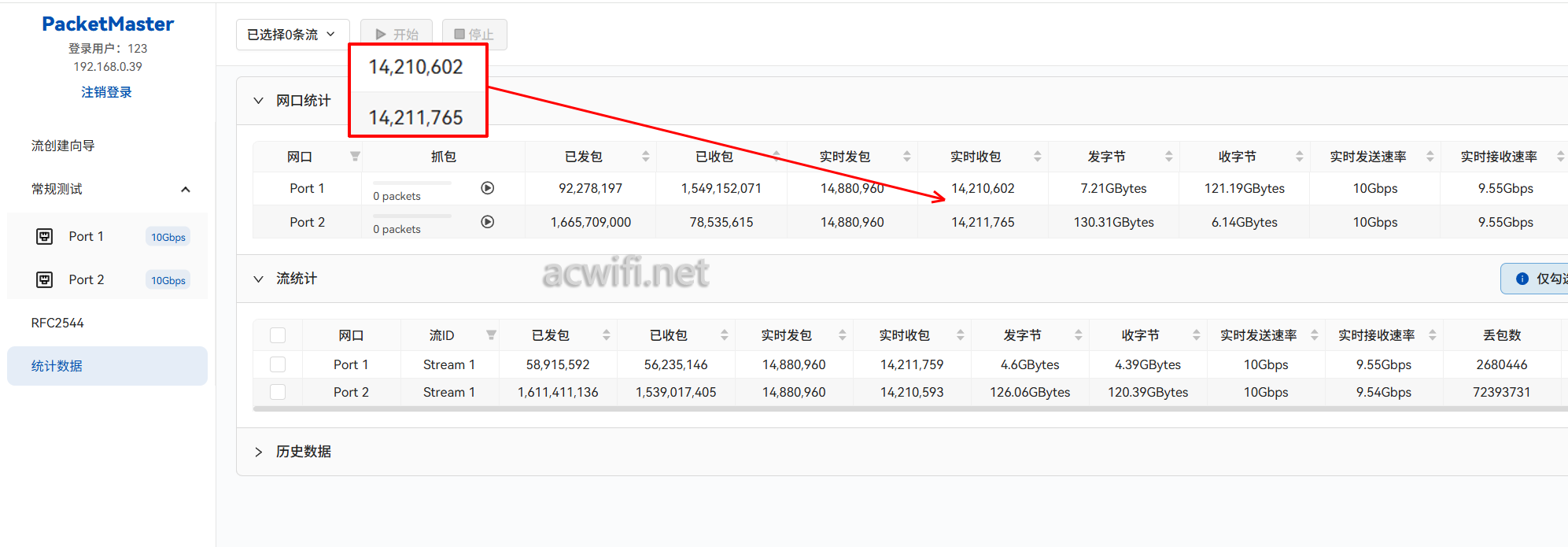
This proves the hardware packet processing engine (PPE / hardware NAT) on the MT7988A can handle intense, low-latency concurrent connections without CPU bottlenecking.
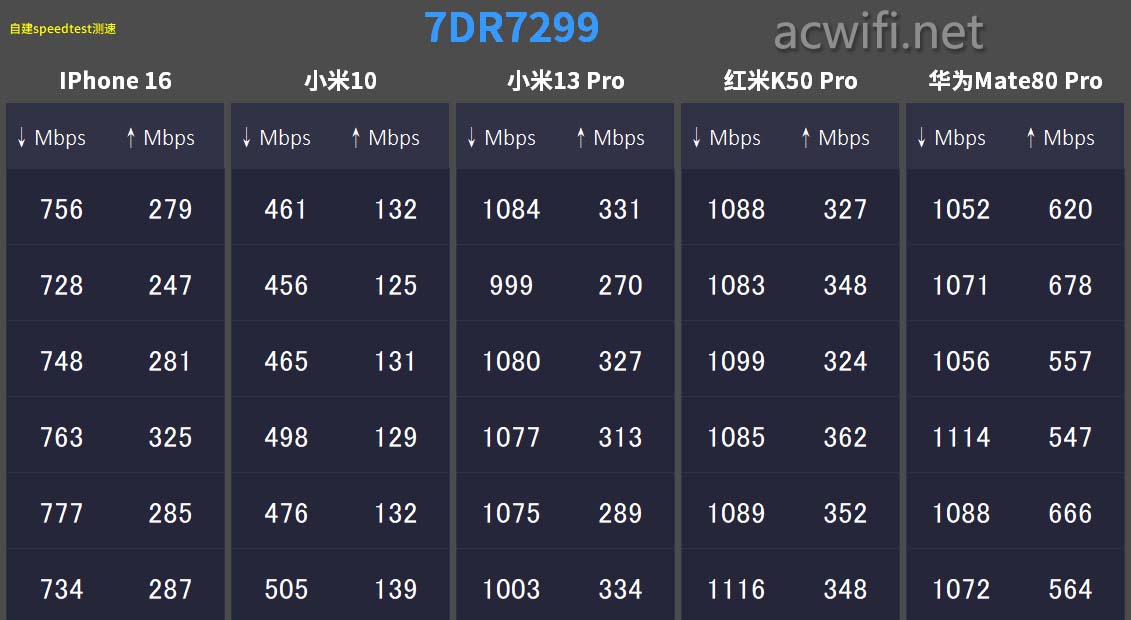
2. Point K Wireless Speed Test (Obstacle-Heavy Corner)
At ACWiFi’s traditional “Point K” location (a far-corner test environment through multiple reinforced concrete walls), the 5GHz band sustained strong RSSI and high data throughput:
3. Roaming Protocols & Beacon Capabilities
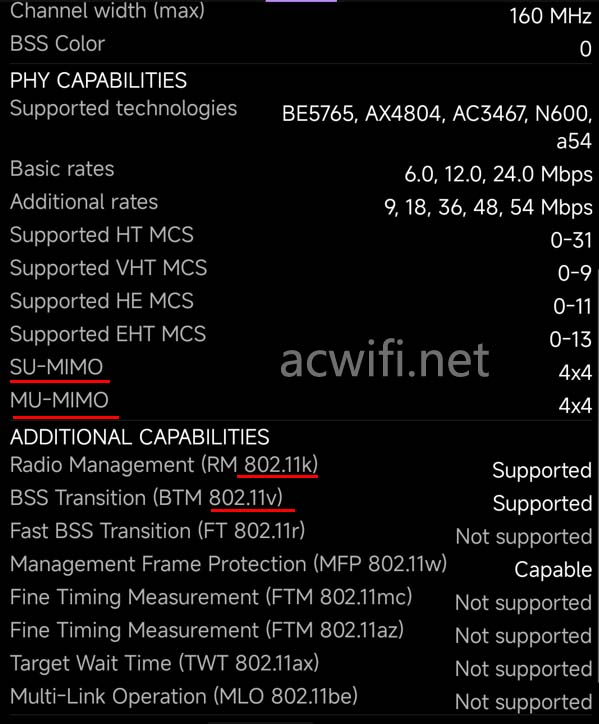
Analyzing the 802.11 beacon frames verifies that the router supports:
- Fast BSS transition via 802.11k (Radio Resource Management) and 802.11v (BSS Transition Management) enabled out of the box.
- Active support for MU-MIMO and explicit Beamforming:
4. Over-The-Air Throughput with MediaTek MT7927 Wi-Fi 7 Client
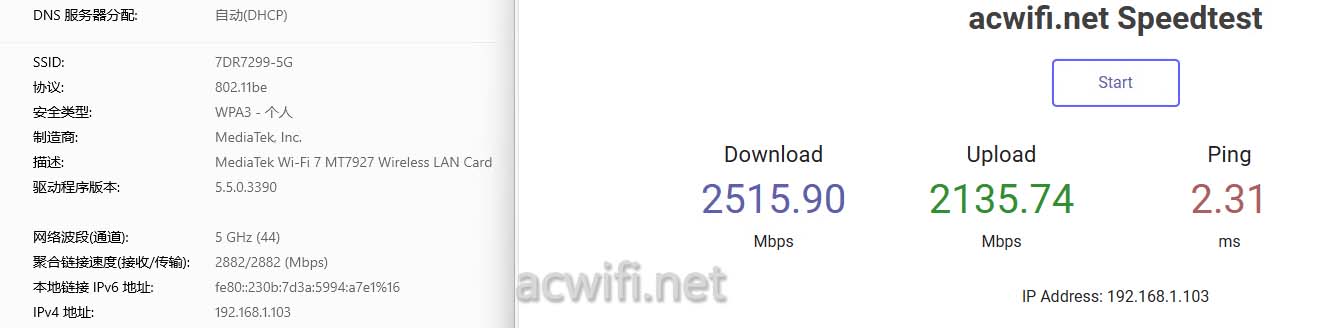
Testing over-the-air throughput against a laptop client equipped with the MediaTek MT7927 Wi-Fi 7 NIC on the 5GHz 160MHz channel delivered sustained transfer rates exceeding 2.8 Gbps:
5. Web Management UI
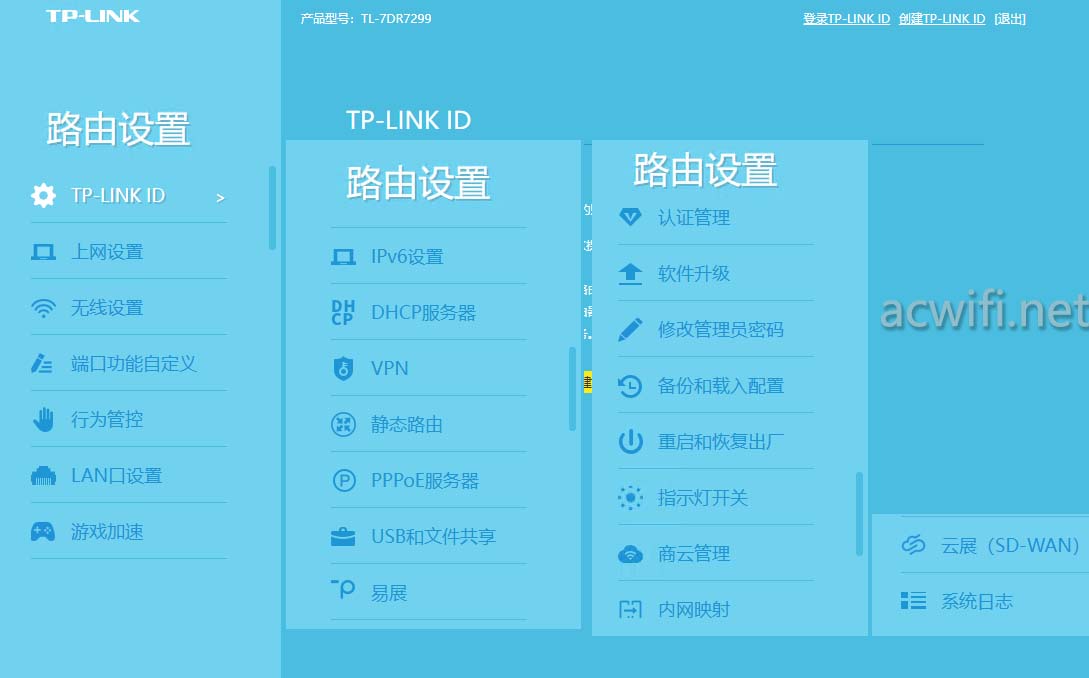
The TP-Link Web interface clearly delineates the physical state of all multi-speed links: the 10G SFP+ slot, 10G RJ45, four 2.5G ports, dual 1G ports, and the USB 3.0 subsystem:
VII. Final Verdict & Buying Recommendations
The TP-Link TL-7DR7299 effectively bundles the robust radio section of the 7DR7260 with higher-powered FEMs, steps up the processing platform to the flagship MediaTek MT7988A (4x A73 @ 1.8GHz), provides an uncompromising port matrix (Dual 10G + Quad 2.5G + Dual 1G), and adds high-speed USB 3.0 Type-C storage expansion.
| Parameter | Specifications (TL-7DR7299) |
|---|---|
| Wi-Fi Class | Wi-Fi 7 BE7200 (2.4G 1376Mbps + 5G 5765Mbps) |
| Processor (SoC) | MediaTek MT7988AV (Quad-core A73 @ 1.8GHz, 12nm) |
| RAM | 1GB DDR4-3200 (EtronTech M16U4G16256A-QLBG x2) |
| Flash Memory | 128MB SPI NAND (ESMT F50L1G41LC) |
| 10G Ports | 2 Ports (1x 10G SFP+ Optical Cage + 1x 10G RJ45 Copper) |
| Additional I/O | 4x 2.5GbE + 2x 1GbE + 1x USB 3.0 Type-C |
| Wireless Silicon | Baseband MT7992A + RF 2.4G MT7976GN + RF 5G MT7977BN |
| RF Amplification | 4x VC5333-21 (2.4G) + 4x KCT8548HE-1 (5G) + 1x LNA MXD7522 |
| Small Packet NAT | 14.21 Mpps bidirectional forwarding (64-byte packets) |
| Firmware Modding | OpenWrt builds available, supports no-disassembly flashing |
Key Highlights:
- Unmatched Port Density per Dollar: Dual 10G ports combined with quad 2.5G ports provide massive flexibility for Multi-Gigabit WAN, high-speed NAS backbones, and HomeLab virtualization.
- Cool Operation & Low Draw: Utilizing a 12nm host CPU and a 6nm Wi-Fi baseband alongside extensive aluminum heat sinking keeps temperatures low and full-port power consumption under ~13.8W.
- OpenWrt Ready: The MT7988A platform is fully supported in open-source networking trees, and OpenWrt can be deployed without opening the physical housing.
Priced around 999 RMB (~$140 USD), if your budget allows and you need an all-in-one multi-gigabit routing engine, the TP-Link TL-7DR7299 is one of the best price-to-performance choices in modern networking. For setups that don’t need 10G uplinks, the 7DR7290 or 7DR7260 remain solid alternatives.
*Source: ACWiFi 33635, published 2026-03-26.
Disassemble
- Viettel SDMC NR3053 Teardown: MediaTek Filogic 820 Platform & Hardware Analysis
- Xiaomi AX3000T New Revision Teardown: Qualcomm IPQ5018 Platform & No Custom ROM Support
- Xiaomi BE3600 1.25A White Teardown: Internal Hardware & Cost-Down Analysis
- TP-LINK TL-7DR7299 Teardown: BE7200 Wi-Fi 7, Dual 10G Ports, Quad 2.5G Ports Reading
- Inside the TP-LINK BE6500 7DR6560 Wi-Fi 7 Router